

Small Language Models vs LLMs: Which Wins?
Introduction
Artificial Intelligence world ತುಂಬಾ fast ಆಗಿ evolve ಆಗುತ್ತಿದೆ. ಕಳೆದ ಕೆಲವು ವರ್ಷಗಳಿಂದ Large Language Models (LLMs) AI industryಯನ್ನು dominate ಮಾಡುತ್ತಿದ್ದವು. ಆದರೆ ಈಗ Small Language Models vs LLMs ಕೂಡ powerful alternative ಆಗಿ emerge ಆಗುತ್ತಿವೆ.
Earlier, many people believed that bigger AI models always meant better performance. ಆದರೆ 2026ರಲ್ಲಿ situation completely change ಆಗುತ್ತಿದೆ. Small Language Models vs LLMs faster inference, lower costs, better privacy ಹಾಗೂ on-device AI capabilities ಮೂಲಕ developers ಮತ್ತು businessesಗೆ attractive option ಆಗಿವೆ.
Whether you’re building AI applications, enterprise software, chatbots ಅಥವಾ mobile apps, Small Language Models ಮತ್ತು LLMs ನಡುವಿನ difference ತಿಳಿದುಕೊಳ್ಳುವುದು ಬಹಳ important.
ಈ articleನಲ್ಲಿ Small Language Models ಎಂದರೇನು, ಅವು ಹೇಗೆ ಕೆಲಸ ಮಾಡುತ್ತವೆ, LLMs ಜೊತೆಗೆ comparison, advantages, limitations ಹಾಗೂ real-world applications ಬಗ್ಗೆ Hybrid Kannada + Englishನಲ್ಲಿ ತಿಳಿಯೋಣ.
As AI adoption grows, the comparison between Small Language Models vs LLMs is becoming a key decision for developers, enterprises, and technology leaders.
What Are Small Language Models?
Small Language Models (SLMs) are compact Artificial Intelligence models designed to understand and generate human language while using significantly fewer parameters than Large Language Models.
ಸರಳವಾಗಿ ಹೇಳುವುದಾದರೆ,
Small Language Models smaller size ಇದ್ದರೂ specific tasksಗೆ highly optimized ಆಗಿರುತ್ತವೆ.
Examples include:
- On-device AI assistants
- Mobile AI applications
- Smart IoT devices
- Offline AI chatbots
- Embedded AI systems
- Enterprise edge AI
ಇವು low computing resources ಇದ್ದರೂ excellent performance provide ಮಾಡಬಹುದು.
Understanding Small Language Models vs LLMs helps organizations select the right AI model based on performance, deployment, and cost.
AI Memory Systems Explained: How AI Remembers Context in 2026
Explore the latest open-source Small Language Models available on Hugging Face.
What Are Large Language Models (LLMs)?
Large Language Models (LLMs) billions or even trillions of parameters ಹೊಂದಿರುವ advanced AI models.
Examples include:
- GPT models
- Claude models
- Gemini models
- Llama models
LLMs large-scale reasoning, content generation, coding, research ಹಾಗೂ multi-domain tasksಗೆ ಅತ್ಯುತ್ತಮವಾಗಿವೆ.
ಆದರೆ ಇವು generally require:
- High GPU power
- Cloud infrastructure
- Higher operational costs
- More memory
- Faster internet connectivity
Why Small Language Models Are Becoming Popular
ಇತ್ತೀಚಿನ AI industry trend ನೋಡಿದರೆ Small Language Models rapidly adopt ಆಗುತ್ತಿವೆ.
Major reasons include:
- Faster response times
- Lower deployment costs
- Better privacy
- Offline capabilities
- Lower energy consumption
- Mobile device compatibility
- Edge AI support
- Enterprise deployment flexibility
Businesses ಈಗ every taskಗೆ huge AI model ಅಗತ್ಯವಿಲ್ಲ ಎಂದು realize ಮಾಡುತ್ತಿವೆ.
The discussion around Small Language Models vs LLMs highlights how compact AI models can deliver efficient performance for many real-world applications.
Learn how Google’s Gemma family demonstrates efficient Small Language Models for developers.
How Small Language Models Work
Modern Small Language Models vs LLMs optimized AI architectures use ಮಾಡುತ್ತವೆ.
Step 1 – Training
Large datasets ಬಳಸಿ model train ಮಾಡಲಾಗುತ್ತದೆ.
↓
Step 2 – Optimization
Model pruning, quantization ಹಾಗೂ knowledge distillation techniques ಮೂಲಕ model size reduce ಮಾಡಲಾಗುತ್ತದೆ.
↓
Step 3 – Deployment
Optimized model smartphones, laptops, IoT devices ಅಥವಾ enterprise serversನಲ್ಲಿ deploy ಆಗುತ್ತದೆ.
↓
Step 4 – Inference
User prompt process ಮಾಡಿ fast response generate ಮಾಡುತ್ತದೆ.
↓
Step 5 – Continuous Improvement
New data ಹಾಗೂ fine-tuning ಮೂಲಕ model performance improve ಮಾಡಲಾಗುತ್ತದೆ.
AI Workflow Automation Master Guide: Automate Business and Personal Tasks in 2026
Small Language Models vs LLMs: Key Differences Explained
| Feature | Small Language Models | Large Language Models |
|---|---|---|
| Model Size | Small | Very Large |
| Speed | Faster | Slower |
| Cost | Lower | Higher |
| Hardware | Laptop/Mobile | Cloud GPUs |
| Privacy | Better | Cloud dependent |
| Internet | Optional | Usually required |
| Power Usage | Low | High |
| Deployment | Edge devices | Data centers |
When evaluating Small Language Models vs LLMs, developers should consider deployment requirements, hardware resources, privacy needs, and overall operating costs before selecting the right AI solution.
Choosing between Small Language Models vs LLMs depends on workload complexity, available hardware, privacy requirements, and budget.
Top 12 AI Coding Agents That Boost Developer Productivity
Explore Meta’s Llama open models and their real-world AI applications.
Where Small Language Models Are Used
Mobile Applications
Smartphone AI assistants faster responses provide ಮಾಡಲು Small Language Models vs LLMs use ಮಾಡುತ್ತವೆ.
Smart Devices
Smart speakers, wearable devices ಹಾಗೂ IoT products efficient AI processingಗಾಗಿ SLMs ಬಳಸುತ್ತವೆ.
Enterprise AI
Companies private infrastructureನಲ್ಲಿ secure AI applications deploy ಮಾಡಲು compact AI models use ಮಾಡುತ್ತಿವೆ.
Healthcare
Medical devices local AI processing ಮೂಲಕ patient data privacy maintain ಮಾಡುತ್ತವೆ.
Manufacturing
Factories edge AI systems ಬಳಸಿ real-time monitoring ಹಾಗೂ predictive maintenance perform ಮಾಡುತ್ತವೆ.
Education
Offline learning applications studentsಗೆ internet ಇಲ್ಲದಿದ್ದರೂ AI assistance provide ಮಾಡುತ್ತವೆ.
Benefits of Small Language Models
Organizations ಹಾಗೂ developersಗೆ Small Language Models ಹಲವು advantages provide ಮಾಡುತ್ತವೆ.
Major benefits include:
- Faster inference
- Lower infrastructure cost
- Reduced latency
- Better privacy
- Energy efficiency
- Offline AI capability
- Faster deployment
- Easy customization
Multi-Agent AI Systems Explained: The Future of Autonomous Collaboration
Discover Microsoft’s Phi Small Language Models designed for efficient on-device AI.
Challenges of Small Language Models
Although Small Language Models vs LLMs highly efficient ಆಗಿದ್ದರೂ ಕೆಲವು limitations ಇವೆ.
Common challenges include:
- Limited general knowledge
- Smaller context window
- Less reasoning capability than large models
- Frequent domain-specific fine-tuning
- Limited multilingual performance in some models
ಅದಕ್ಕಾಗಿ use caseಗೆ ಅನುಗುಣವಾಗಿ correct AI model choose ಮಾಡುವುದು important.
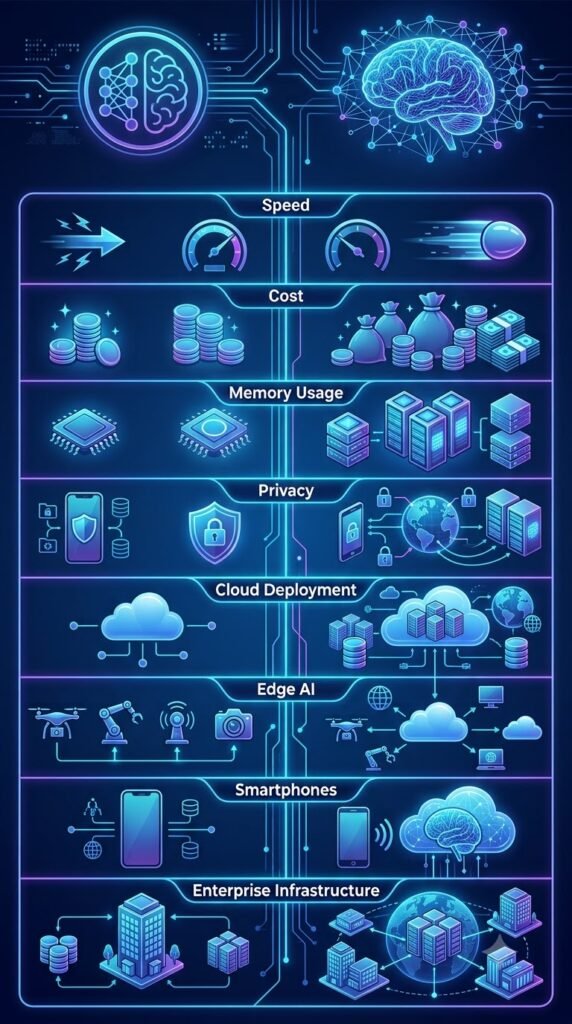
Performance Comparison: Small Language Models vs LLMs
Choosing between Small Language Models vs LLMs and Large Language Models (LLMs) depends on your requirements. Bigger model ಅಂದರೆ ಯಾವಾಗಲೂ better ಅನ್ನೋದಿಲ್ಲ. Use case, budget, hardware ಹಾಗೂ response time ಕೂಡ equally important factors.
ಕೆಲವು applicationsಗೆ Small Language Models perfect choice ಆಗಿದ್ದರೆ, complex reasoning tasksಗೆ LLMs still better perform ಮಾಡುತ್ತವೆ.
Comparison Overview
| Feature | Small Language Models | Large Language Models |
|---|---|---|
| Speed | Very Fast | Moderate |
| Reasoning | Good | Excellent |
| Cost | Low | High |
| Deployment | Local Devices | Cloud Infrastructure |
| Energy Usage | Low | High |
| Privacy | Excellent | Moderate |
| Offline Support | Yes | Mostly No |
| Scalability | Easy | Resource Intensive |
Why Businesses Are Choosing Small Language Models
Many organizations ಈಗ every AI taskಗೆ massive cloud models use ಮಾಡುವುದನ್ನು avoid ಮಾಡುತ್ತಿವೆ.
Small Language Models businessesಗೆ cost-effective ಹಾಗೂ secure AI deployment option provide ಮಾಡುತ್ತವೆ.
Major reasons include:
Lower Operational Cost
Cloud GPU expenses significantly reduce ಆಗುತ್ತವೆ.
Faster Response Time
Local processing ಇರುವುದರಿಂದ latency ತುಂಬಾ ಕಡಿಮೆ.
Better Privacy
Sensitive customer data organization network ಹೊರಗೆ ಹೋಗಬೇಕಾಗಿಲ್ಲ.
Offline Availability
Internet connection ಇಲ್ಲದಿದ್ದರೂ AI applications run ಮಾಡಬಹುದು.
Easy Deployment
Laptops, industrial PCs, smartphones ಹಾಗೂ IoT devicesನಲ್ಲಿ deploy ಮಾಡಬಹುದು.
How Small Language Models Improve Edge AI
Edge AI ಅಂದರೆ cloud serverಗೆ data ಕಳುಹಿಸದೆ deviceಲ್ಲೇ Artificial Intelligence run ಆಗುವುದು.
Small Language Models Edge AIಗೆ ಅತ್ಯುತ್ತಮ solution ಆಗಿವೆ.
Common Edge AI Applications
- Smart Cameras
- Industrial Robots
- Medical Equipment
- Smart Vehicles
- Security Systems
- Retail Kiosks
- Wearable Devices
- Smart Home Automation
ಈ applicationsನಲ್ಲಿ instant decisions ಅಗತ್ಯ ಇರುವುದರಿಂದ Small Language Models better choice ಆಗುತ್ತವೆ.
Learn how NVIDIA Edge AI enables efficient deployment of Small Language Models.
Real-World Applications of Small Language Models
Healthcare
Hospitals patient information locally process ಮಾಡಿ privacy maintain ಮಾಡಬಹುದು.
Doctors faster diagnosis support ಪಡೆಯಬಹುದು.
Manufacturing
Factories production monitoring, defect detection ಹಾಗೂ predictive maintenanceಗಾಗಿ compact AI models ಬಳಸುತ್ತಿವೆ.
Banking
Banks fraud detection ಹಾಗೂ secure customer support applicationsಗೆ Small Language Models deploy ಮಾಡುತ್ತಿವೆ.
Education
Offline AI tutors studentsಗೆ internet ಇಲ್ಲದಿದ್ದರೂ learning assistance provide ಮಾಡುತ್ತವೆ.
Retail
Retail stores inventory management, customer assistance ಹಾಗೂ smart checkout systemsನಲ್ಲಿ AI integrate ಮಾಡುತ್ತಿವೆ.
Automotive Industry
Connected vehicles voice assistants, navigation ಹಾಗೂ driver assistance featuresಗೆ efficient AI models use ಮಾಡುತ್ತಿವೆ.
Where Large Language Models Still Win
Although Small Language Models vs LLMs rapidly improving ಆಗುತ್ತಿದ್ದರೂ ಕೆಲವು tasksನಲ್ಲಿ LLMs ಇನ್ನೂ leading position maintain ಮಾಡುತ್ತಿವೆ.
LLMs excel in:
- Advanced reasoning
- Long-form content generation
- Research assistance
- Software development
- Scientific analysis
- Complex coding
- Multi-language translation
- Creative writing
Highly complex enterprise workflowsಗೆ LLMs ಇನ್ನೂ preferred choice ಆಗಿವೆ.
Cost Comparison
Organizations AI deployment planning ಮಾಡುವಾಗ cost major factor ಆಗಿದೆ.
Small Language Models
- Lower infrastructure cost
- Lower cloud expenses
- Less GPU requirement
- Affordable deployment
- Lower maintenance
Large Language Models
- High GPU cost
- Cloud subscription expenses
- Enterprise infrastructure
- Large storage requirements
- Higher operational spending
Budget-conscious businessesಗೆ Small Language Models attractive solution ಆಗಿವೆ.
The debate around Small Language Models vs LLMs often comes down to infrastructure costs and long-term scalability.
Small Language Models for Developers
Developers increasingly Small Language Models use ಮಾಡುತ್ತಿದ್ದಾರೆ.
Popular development use cases include:
- Local AI assistants
- Code completion
- Documentation generation
- Smart search
- Offline chatbot development
- API automation
Developers faster experimentation ಹಾಗೂ lower deployment cost experience ಮಾಡುತ್ತಿದ್ದಾರೆ.
Enterprise Adoption
Large organizations hybrid AI strategy adopt ಮಾಡುತ್ತಿವೆ.
Internal Tasks
Small Language Models use ಮಾಡುತ್ತಾರೆ.
Examples:
- HR chatbot
- IT helpdesk
- Internal documentation
- Employee search
Many enterprises are comparing Small Language Models vs LLMs to determine which architecture best fits their business applications.
Complex Tasks
LLMs ಬಳಸುತ್ತಾರೆ.
Examples:
- Market research
- Business analytics
- Strategic planning
- Advanced report generation
ಈ hybrid approach cost optimize ಮಾಡುವ ಜೊತೆಗೆ performance ಕೂಡ improve ಮಾಡುತ್ತದೆ.
Benefits of Small Language Models
Organizations adopting Small Language Models ಹಲವಾರು benefits ಪಡೆಯುತ್ತಿವೆ.
Major advantages include:
- Faster inference
- Lower deployment cost
- Better privacy
- Offline capability
- Low power consumption
- Easy customization
- Faster deployment
- Better scalability for edge devices
Challenges of Small Language Models
Despite many advantages, Small Language Models ಕೆಲವು limitations ಹೊಂದಿವೆ.
Limited Knowledge
Training data comparatively smaller ಆಗಿರಬಹುದು.
Reduced Context Window
Very long conversations handle ಮಾಡಲು limitations ಇರಬಹುದು.
Domain-Specific Training
Specialized industriesಗೆ additional fine-tuning ಅಗತ್ಯವಾಗಬಹುದು.
Lower Reasoning Capability
Highly complex analytical tasksನಲ್ಲಿ LLMs generally better perform ಮಾಡುತ್ತವೆ.
Frequent Updates
Performance maintain ಮಾಡಲು periodic retraining ಹಾಗೂ optimization ಅಗತ್ಯ.
Latest Trends in Small Language Models
2026ರಲ್ಲಿ Small Language Models ecosystem rapidly grow ಆಗುತ್ತಿದೆ.
Major innovations include:
- On-device AI
- AI smartphones
- Tiny Transformer Models
- Edge AI Computing
- Private Enterprise AI
- AI PCs
- Quantized Language Models
- Energy-Efficient AI
- Federated AI Learning
- AI-powered IoT Devices
ಈ technologies AI adoption ಅನ್ನು consumer devices ಹಾಗೂ enterprise environments ಎರಡರಲ್ಲೂ accelerate ಮಾಡುತ್ತಿವೆ.
The Future of Small Language Models
Small Language Models Artificial Intelligence futureನಲ್ಲಿ rapidly growing technology ಆಗಿವೆ. Earlier, most AI applications massive cloud-based LLMs ಮೇಲೆ depend ಆಗಿದ್ದವು. ಆದರೆ ಈಗ organizations faster, affordable ಹಾಗೂ privacy-focused AI solutions ಹುಡುಕುತ್ತಿರುವುದರಿಂದ Small Language Models adoption ವೇಗವಾಗಿ ಹೆಚ್ಚುತ್ತಿದೆ.
ಮುಂದಿನ ಕೆಲವು ವರ್ಷಗಳಲ್ಲಿ AI smartphones, AI PCs, wearable devices, industrial robots ಹಾಗೂ autonomous vehiclesಗಳಲ್ಲಿ Small Language Models default AI engine ಆಗುವ ಸಾಧ್ಯತೆ ಇದೆ.
Future innovations include:
- AI PCs with built-in language models
- Edge AI Computing
- Offline AI Assistants
- AI-Powered Smart Devices
- Personalized AI Models
- Federated AI Learning
- Tiny Transformer Models
- Enterprise On-Premise AI
ಈ innovations AI ಅನ್ನು ಇನ್ನಷ್ಟು accessible, secure ಹಾಗೂ efficient ಮಾಡಲಿವೆ.
The future of Small Language Models vs LLMs is expected to be hybrid, where both model types work together for different AI workloads.
Will Small Language Models Replace LLMs?
Simple answer — No.
Small Language Models ಹಾಗೂ Large Language Models (LLMs) ಎರಡಕ್ಕೂ ತಮ್ಮದೇ strengths ಇವೆ.
Small Language Models Are Best For
- Mobile applications
- Edge AI
- Offline assistants
- IoT devices
- Privacy-focused applications
- Enterprise internal tools
- Low-cost deployment
- Fast inference
Large Language Models Are Best For
- Advanced reasoning
- Long-form content generation
- Scientific research
- Software engineering
- Business analytics
- Complex problem solving
- Multi-domain conversations
- Large enterprise AI platforms
Future AI ecosystemನಲ್ಲಿ Small Language Models ಮತ್ತು LLMs together work ಮಾಡುವ hybrid approach ಹೆಚ್ಚು popular ಆಗಲಿದೆ.
Real-World Example
Imagine ಒಂದು hospital AI system deploy ಮಾಡುತ್ತಿದೆ.
Using Only LLMs
- Patient data cloudಗೆ upload ಆಗುತ್ತದೆ.
- High operational cost ಬರುತ್ತದೆ.
- Internet dependency ಇರುತ್ತದೆ.
- Response latency slightly increase ಆಗಬಹುದು.
Using Small Language Models
Step 1
Patient data hospital serverಲ್ಲೇ process ಆಗುತ್ತದೆ.
↓
Step 2
AI instantly analyze ಮಾಡುತ್ತದೆ.
↓
Step 3
Doctorಗೆ quick recommendations provide ಮಾಡುತ್ತದೆ.
↓
Step 4
Sensitive data local environmentನಲ್ಲೇ remain ಆಗುತ್ತದೆ.
↓
Step 5
Faster decision-making possible ಆಗುತ್ತದೆ.
Result?
Better privacy, lower cost ಹಾಗೂ faster AI performance.
Industries That Will Benefit the Most
Many industries Small Language Models ಮೂಲಕ major transformation experience ಮಾಡುವ ಸಾಧ್ಯತೆ ಇದೆ.
Healthcare
Patient privacy maintain ಮಾಡಿ faster diagnosis support provide ಮಾಡಬಹುದು.
Banking
Secure financial applications local AI processing ಮೂಲಕ improve ಆಗುತ್ತವೆ.
Manufacturing
Factories real-time monitoring ಹಾಗೂ predictive maintenance efficiently perform ಮಾಡಬಹುದು.
Education
Offline AI tutors rural areasಗೂ quality education deliver ಮಾಡಬಹುದು.
Retail
Inventory management, customer support ಹಾಗೂ smart checkout systems faster ಆಗುತ್ತವೆ.
Automotive
Connected cars voice assistants ಹಾಗೂ driver support systems local AI ಮೂಲಕ operate ಮಾಡಬಹುದು.
Smart Cities
Traffic management, surveillance ಹಾಗೂ public services AI edge computing ಮೂಲಕ enhance ಆಗುತ್ತವೆ.
Challenges of Small Language Models
Although Small Language Models highly efficient ಆಗಿದ್ದರೂ ಕೆಲವು challenges remain.
Limited Knowledge Base
Very broad topicsನಲ್ಲಿ LLMsಗೆ ಹೋಲಿಸಿದರೆ knowledge ಕಡಿಮೆ ಇರಬಹುದು.
Complex Reasoning
Advanced logical reasoning tasksನಲ್ಲಿ performance slightly lower ಇರಬಹುದು.
Continuous Fine-Tuning
Specific industriesಗೆ regular model updates ಅಗತ್ಯವಾಗಬಹುದು.
Hardware Limitations
Very small devices limited processing power ಹೊಂದಿರಬಹುದು.
Data Quality
High-quality training data ಇಲ್ಲದಿದ್ದರೆ model performance affect ಆಗಬಹುದು.
Best Practices for Using Small Language Models
Organizations Small Language Models deploy ಮಾಡುವಾಗ ಈ best practices follow ಮಾಡಬೇಕು.
Choose the Right Model
Every projectಗೆ same AI model use ಮಾಡಬೇಡಿ.
Fine-Tune for Your Domain
Industry-specific datasets use ಮಾಡಿ better accuracy achieve ಮಾಡಬಹುದು.
Prioritize Security
Sensitive information encrypt ಮಾಡಿ secure infrastructure maintain ಮಾಡಬೇಕು.
Monitor Performance
Regular benchmarking ಹಾಗೂ performance evaluation ಮಾಡಬೇಕು.
Combine with LLMs When Needed
Hybrid AI architecture use ಮಾಡಿದರೆ best results ಪಡೆಯಬಹುದು.
Frequently Asked Questions (FAQs)
1. Small Language Models ಎಂದರೇನು?
Small Language Models ಅಂದರೆ fewer parameters ಹೊಂದಿರುವ compact AI models. ಇವು faster inference, lower resource usage ಹಾಗೂ efficient deploymentಗಾಗಿ design ಮಾಡಲಾಗಿದೆ.
2. Small Language Models ಮತ್ತು LLMs ನಡುವಿನ ಮುಖ್ಯ difference ಏನು?
Small Language Models lightweight, cost-effective ಹಾಗೂ edge devicesಗೆ suitable ಆಗಿವೆ.
LLMs complex reasoning, large-scale knowledge ಹಾಗೂ advanced content generationನಲ್ಲಿ better perform ಮಾಡುತ್ತವೆ.
There is no single winner in Small Language Models vs LLMs. Small Language Models are ideal for edge devices and fast inference, while LLMs excel in advanced reasoning and large-scale content generation.
3. Small Language Models internet ಇಲ್ಲದೆ work ಮಾಡುತ್ತವೆಯೇ?
ಹೌದು.
ಬಹಳಷ್ಟು Small Language Models laptops, smartphones ಹಾಗೂ edge devicesನಲ್ಲಿ offline modeಲ್ಲೂ run ಆಗಬಹುದು.
4. Businesses ಯಾವಾಗ Small Language Models choose ಮಾಡಬೇಕು?
Organizationsಗೆ privacy, lower infrastructure cost, fast response ಹಾಗೂ local deployment important ಆಗಿದ್ದರೆ Small Language Models excellent choice ಆಗುತ್ತವೆ.
5. Futureನಲ್ಲಿ Small Language Models ಹೆಚ್ಚು popular ಆಗುತ್ತವೆಯೇ?
ಹೌದು.
AI PCs, Edge AI, smartphones ಹಾಗೂ enterprise automation growth ಜೊತೆಗೆ Small Language Models adoption significantly increase ಆಗುವ ಸಾಧ್ಯತೆ ಇದೆ.
Expert Insights
AI researchers ಹಾಗೂ enterprise technology experts ಅಭಿಪ್ರಾಯದ ಪ್ರಕಾರ Small Language Models future AI ecosystemನಲ್ಲಿ very important role play ಮಾಡಲಿವೆ.
Experts recommend:
- Use Small Language Models for edge AI applications.
- Deploy LLMs only where advanced reasoning is required.
- Fine-tune models using domain-specific datasets.
- Protect user privacy with secure on-premise deployment.
- Continuously monitor AI performance.
- Adopt hybrid AI architecture for maximum efficiency.
ಈ approach organizationsಗೆ cost savings ಹಾಗೂ better AI performance ಎರಡನ್ನೂ provide ಮಾಡುತ್ತದೆ.
Future Trends to Watch
Small Language Models ecosystem very rapidly evolve ಆಗುತ್ತಿದೆ.
Major future trends include:
- AI PCs
- Edge AI Computing
- Tiny Transformer Models
- AI Smartphones
- Federated Learning
- Personalized AI Models
- On-Device AI Assistants
- Green AI
- Energy-Efficient AI
- Hybrid AI Systems
ಈ innovations AI technologyನ್ನು faster, cheaper ಹಾಗೂ environmentally sustainable ಮಾಡಲಿವೆ.
The future of Small Language Models vs LLMs will likely involve hybrid AI architectures that combine the strengths of both approaches.
Final Verdict
Small Language Models Artificial Intelligence industryಗೆ game-changing innovation ಆಗಿವೆ.
ಇವು faster inference, lower deployment cost, enhanced privacy ಹಾಗೂ offline capabilities provide ಮಾಡುವ ಮೂಲಕ businesses ಮತ್ತು developersಗೆ powerful alternative ಆಗಿವೆ.
ಆದರೆ LLMs completely replace ಆಗುವುದಿಲ್ಲ. Instead, Small Language Models ಮತ್ತು LLMs together work ಮಾಡುವ hybrid AI strategy future enterprise AI architectureನಲ್ಲಿ standard approach ಆಗುವ ಸಾಧ್ಯತೆ ಇದೆ.
For most businesses, Small Language Models vs LLMs is not about finding a single winner but choosing the right model for each specific use case.
Conclusion
The discussion around Small Language Models vs LLMs shows that both technologies have unique strengths and are likely to coexist in the future AI ecosystem.
Small Language Models businesses, developers ಹಾಗೂ consumersಗೆ affordable, privacy-focused ಹಾಗೂ high-performance AI solutions provide ಮಾಡುತ್ತಿವೆ.
Edge AI, AI PCs, mobile applications ಹಾಗೂ enterprise automation growth ಜೊತೆಗೆ Small Language Models adoption ಮುಂದಿನ ವರ್ಷಗಳಲ್ಲಿ ಮತ್ತಷ್ಟು increase ಆಗುವ ನಿರೀಕ್ಷೆಯಿದೆ.
Organizations right balance between Small Language Models and LLMs choose ಮಾಡಿದರೆ cost, performance ಹಾಗೂ scalability ಮೂವನ್ನೂ optimize ಮಾಡಬಹುದು.
Key Takeaways
- Small Language Models faster ಹಾಗೂ lightweight AI solutions provide ಮಾಡುತ್ತವೆ.
- Edge AI, mobile devices ಹಾಗೂ offline applicationsಗೆ ಇವು ಅತ್ಯುತ್ತಮ choice.
- LLMs complex reasoning ಹಾಗೂ large-scale content generationನಲ್ಲಿ still stronger.
- Hybrid AI architecture future enterprise AIಗೆ best approach ಆಗಲಿದೆ.
- Small Language Models lower cost ಹಾಗೂ better privacy offer ಮಾಡುತ್ತವೆ.
- Fine-tuning improves domain-specific performance.
- AI PCs ಹಾಗೂ Edge AI growth ಜೊತೆಗೆ Small Language Models demand increase ಆಗುತ್ತಿದೆ.
- Choosing the right AI model depends on your specific business or technical requirements.
Final Article Summary
ಈ ಮೂರು ಭಾಗಗಳ articleನಲ್ಲಿ Small Language Models ಬಗ್ಗೆ complete understanding ಪಡೆದಿದ್ದೇವೆ. ಮೊದಲ ಭಾಗದಲ್ಲಿ Small Language Models ಎಂದರೇನು, ಅವು ಹೇಗೆ work ಮಾಡುತ್ತವೆ, LLMs ಜೊತೆ basic comparison ಹಾಗೂ real-world applications ಬಗ್ಗೆ ತಿಳಿದುಕೊಂಡೆವು.
ಎರಡನೇ ಭಾಗದಲ್ಲಿ performance comparison, cost analysis, enterprise adoption, edge AI, developer use cases, benefits, limitations ಹಾಗೂ latest industry trends ಅನ್ನು Hybrid Kannada + Englishನಲ್ಲಿ ವಿವರವಾಗಿ ನೋಡಿದೆವು.
ಈ ಮೂರನೇ ಭಾಗದಲ್ಲಿ future of Small Language Models, FAQs, expert insights, best practices, emerging trends, conclusion ಹಾಗೂ key takeaways ಬಗ್ಗೆ ಸಂಪೂರ್ಣವಾಗಿ ತಿಳಿದುಕೊಂಡೆವು.
ಒಟ್ಟಿನಲ್ಲಿ, Small Language Models modern AI ecosystemನಲ್ಲಿ lightweight, secure ಹಾಗೂ cost-effective solution ಆಗಿ rapidly grow ಆಗುತ್ತಿವೆ. LLMs ಜೊತೆಗೆ hybrid approach adopt ಮಾಡಿದರೆ organizations faster deployment, improved privacy, better scalability ಹಾಗೂ optimized AI performance achieve ಮಾಡಬಹುದು.
Understanding Small Language Models vs LLMs helps developers and businesses choose the right AI model based on performance, privacy, cost, and deployment needs.