
AI Scientists Explained: Can Artificial Intelligence Discover New Science?
Introduction
ಇತ್ತೀಚಿನ ವರ್ಷಗಳಲ್ಲಿ AI coding ಮಾಡುತ್ತಿದೆ, images generate ಮಾಡುತ್ತಿದೆ, videos create ಮಾಡುತ್ತಿದೆ.
ಆದರೆ ಈಗ ಒಂದು ಹೊಸ ಪ್ರಶ್ನೆ ಕೇಳಲಾಗುತ್ತಿದೆ.
“Can an AI Scientist discover completely new science?”
ಇದು science fiction ಅಲ್ಲ.
Modern AI Scientist systems research papers ಓದಬಹುದು, new hypotheses generate ಮಾಡಬಹುದು, experiments design ಮಾಡಬಹುದು, results analyze ಮಾಡಬಹುದು ಮತ್ತು research papers ಕೂಡ draft ಮಾಡಬಹುದು. Current systems aim to automate large parts of the research workflow, although human oversight is still essential.
Healthcare, Biology, Physics, Chemistry ಹಾಗೂ Materials Science ಸೇರಿದಂತೆ ಅನೇಕ research fieldsನಲ್ಲಿ Scientific AI ಈಗಾಗಲೇ researchersಗೆ powerful assistant ಆಗುತ್ತಿದೆ.
ಈ articleನಲ್ಲಿ AI Scientist ಎಂದರೇನು, ಅದು ಹೇಗೆ ಕೆಲಸ ಮಾಡುತ್ತದೆ, human scientistsನಿಂದ ಹೇಗೆ different, real-world applications, advantages ಹಾಗೂ future possibilities ಬಗ್ಗೆ Hybrid Kannada + Englishನಲ್ಲಿ detailವಾಗಿ ತಿಳಿದುಕೊಳ್ಳೋಣ.
What is an AI Scientist?
AI Scientist ಅಂದರೆ scientific research processನ ಹಲವು ಹಂತಗಳನ್ನು Artificial Intelligence ಮೂಲಕ automate ಮಾಡಲು design ಮಾಡಿರುವ intelligent system.
ಒಬ್ಬ human researcher ಮಾಡುವ ಹಲವಾರು tasksಗಳನ್ನು AI support ಮಾಡಬಹುದು.
Examples:
- Literature Review
- Hypothesis Generation
- Experiment Planning
- Data Analysis
- Scientific Writing
- Result Visualization
- Research Summarization
Current systems are designed to assist and automate many research steps, but they still benefit from human validation and oversight.
Why Are AI Scientists Becoming Important?
ಪ್ರತಿ ವರ್ಷ ಲಕ್ಷಾಂತರ research papers publish ಆಗುತ್ತವೆ.
Human researchersಗೆ ಎಲ್ಲಾ papers ಓದುವುದು practically impossible.
ಇಲ್ಲಿ Scientist AI systems help ಮಾಡುತ್ತವೆ.
Advantages include:
- Faster literature review
- Better pattern recognition
- Faster experiment planning
- Large-scale data analysis
- Reduced repetitive work
- Improved research productivity
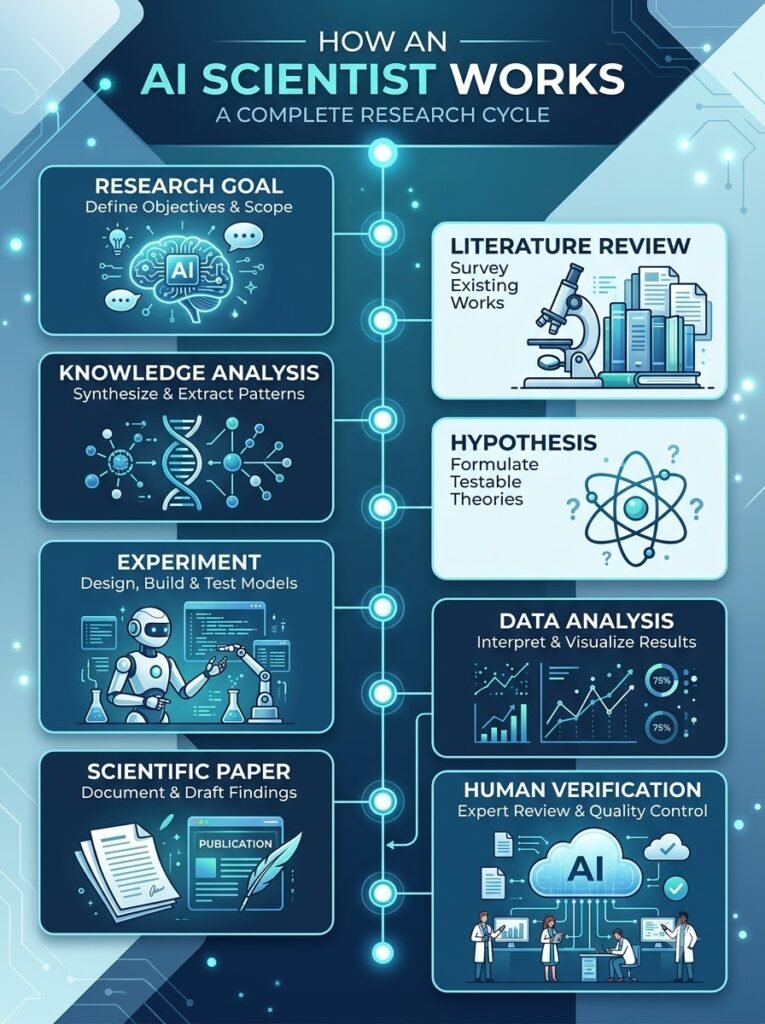
How Does an AI Scientist Work?
ಒಂದು modern Scientist AI ಸಾಮಾನ್ಯವಾಗಿ ಈ workflow follow ಮಾಡುತ್ತದೆ.
Research Goal ↓Literature Search ↓Knowledge Analysis ↓Hypothesis Generation ↓Experiment Design ↓Simulation / Testing ↓Result Analysis ↓Paper Draft ↓Human Review
ಈ complete workflow autonomous research systemsನ core idea ಆಗಿದೆ.
Nature: How to Build an AI Scientist
Core Technologies Behind AI Scientists
Scientific AI ಹಲವು advanced technologies combine ಮಾಡಿ ಕೆಲಸ ಮಾಡುತ್ತದೆ.
Large Language Models (LLMs)
Research papers ಅರ್ಥಮಾಡಿಕೊಳ್ಳಲು.
Machine Learning
Patterns discover ಮಾಡಲು.
Knowledge Graphs
Scientific concepts connect ಮಾಡಲು.
Computer Vision
Scientific images analyze ಮಾಡಲು.
Robotics
Physical laboratory experiments automate ಮಾಡಲು.
Reinforcement Learning
Better research strategies learn ಮಾಡಲು.
Scientific Databases
Millions of published papers analyze ಮಾಡಲು.
AI Scientists Get a New Discovery Framework: How BLAZE Could Transform Scientific Research
Can AI Really Discover New Science?
ಇದು ಅತ್ಯಂತ interesting question.
Current AI systems completely independent scientist ಆಗಿಲ್ಲ.
ಆದರೆ AI ಈಗಾಗಲೇ:
- New research ideas suggest ಮಾಡುತ್ತಿದೆ.
- Existing knowledge combine ಮಾಡುತ್ತಿದೆ.
- Hidden patterns identify ಮಾಡುತ್ತಿದೆ.
- Large datasets analyze ಮಾಡುತ್ತಿದೆ.
- Experiments prioritize ಮಾಡಲು ಸಹಾಯ ಮಾಡುತ್ತಿದೆ.
Recent autonomous research systems have demonstrated end-to-end research pipelines in machine learning, though experts emphasize that human verification remains critical.
Ambient AI Explained: How Invisible AI Will Transform Daily Life
AI Scientist vs Human Scientist
| Feature | AI Scientist | Human Scientist |
|---|---|---|
| Reads Millions of Papers | ✅ | Limited |
| Creativity | Limited | Excellent |
| Pattern Recognition | Excellent | Good |
| Emotional Intelligence | ❌ | ✅ |
| Ethical Decisions | ❌ | ✅ |
| Scientific Intuition | Limited | Excellent |
| Speed | Very High | Moderate |
| Independent Judgment | Limited | Excellent |
ಇಂದಿನ realityನಲ್ಲಿ best approach ಎಂದರೆ Human + AI Collaboration.
Real-World Applications
Scientist AI technology ಈಗ ಹಲವಾರು industriesನಲ್ಲಿ ಬಳಸಲಾಗುತ್ತಿದೆ.
Drug Discovery
New medicines identify ಮಾಡಲು.
Healthcare
Disease prediction ಹಾಗೂ treatment research.
Biology
Protein analysis
Gene research
Cell behavior
Chemistry
Material discovery
Chemical simulations
Climate Science
Weather prediction
Climate modeling
Environmental research
Space Research
Satellite analysis
Planetary research
Astronomy
Brain-Computer Interface AI: How Humans May Interact with AI in the Future
Popular AI Scientist Projects
ಕೆಲವು well-known research initiatives:
- Sakana AI – The AI Scientist
- Google DeepMind scientific research projects
- Microsoft AI for Science
- IBM Research AI
- FutureHouse research agents
These projects explore how AI can accelerate scientific workflows rather than replace scientists.
FutureHouse – AI for Scientific Discovery
Why Researchers Use AI Scientists
Research teams AI systems ಬಳಸುವ ಪ್ರಮುಖ ಕಾರಣಗಳು:
✅ Faster literature review
✅ Better data analysis
✅ Automated documentation
✅ Scientific visualization
✅ Hypothesis generation
✅ Time savings
✅ Large dataset analysis
Build Your First AI Knowledge Base Using Modern AI Tools
How an AI Scientist Generates New Research Ideas
ಒಬ್ಬ Scientist AI research papers ಮಾತ್ರ ಓದುವುದಿಲ್ಲ. ಈಗಾಗಲೇ available knowledge analyze ಮಾಡಿ ಹೊಸ research directions ಕೂಡ suggest ಮಾಡಬಹುದು.
Typical workflow:
Research Papers
↓
Knowledge Extraction
↓
Pattern Recognition
↓
Gap Identification
↓
Hypothesis Generation
↓
Experiment Planning
↓
Human Review
ಈ approach researchersಗೆ months ತೆಗೆದುಕೊಳ್ಳುವ literature review ಅನ್ನು significantly faster ಮಾಡಬಹುದು.
Step 1: Literature Review at Scale
Traditional researchನಲ್ಲಿ literature review ತುಂಬಾ time-consuming process.
ಒಬ್ಬ researcher ನೂರಾರು papers ಓದಬೇಕಾಗಬಹುದು.
AI Scientist however:
- Millions of research papers analyze ಮಾಡಬಹುದು.
- Related studies compare ಮಾಡಬಹುದು.
- Duplicate research identify ಮಾಡಬಹುದು.
- Missing knowledge gaps detect ಮಾಡಬಹುದು.
- Recent discoveries summarize ಮಾಡಬಹುದು.
ಇದರಿಂದ researchers ಹೆಚ್ಚು ಸಮಯ actual innovationಗೆ spend ಮಾಡಬಹುದು.
Step 2: Knowledge Graph Creation
Scientific information usually isolated papersನಲ್ಲಿ ಇರುತ್ತದೆ.
Scientist AI knowledge graphs create ಮಾಡಿ concepts ನಡುವೆ relationships build ಮಾಡುತ್ತದೆ.
Example:
Gene
↓
Protein
↓
Disease
↓
Drug
↓
Clinical Trial
ಈ connected knowledge ಮೂಲಕ hidden relationships discover ಮಾಡುವ ಸಾಧ್ಯತೆ ಹೆಚ್ಚಾಗುತ್ತದೆ.
Step 3: Hypothesis Generation
Scientific researchನ heart ಅಂದರೆ hypothesis.
Modern Scientist AI systems existing evidence analyze ಮಾಡಿ possible hypotheses suggest ಮಾಡುತ್ತವೆ.
Example:
Existing Drug
↓
Similar Protein
↓
Disease Pattern
↓
Possible New Treatment
↓
Human Validation
AI suggestion ಕೊಡಬಹುದು, ಆದರೆ scientific approval ಇನ್ನೂ human experts ಕೈಯಲ್ಲೇ ಇರುತ್ತದೆ.
Step 4: Experiment Design
ಒಳ್ಳೆಯ experiment design ಮಾಡುವುದು researchನಲ್ಲಿ ಅತ್ಯಂತ important.
Scientific AI researchersಗೆ suggest ಮಾಡಬಹುದು:
- Required datasets
- Experimental variables
- Control groups
- Success metrics
- Expected outcomes
- Statistical methods
ಇದರಿಂದ experiment planning ಹೆಚ್ಚು systematic ಆಗುತ್ತದೆ.
Step 5: Simulation Before Real Experiments
ಪ್ರತಿ experiment laboratoryನಲ್ಲಿ ಮಾಡುವುದು expensive ಹಾಗೂ time-consuming.
ಆದ್ದರಿಂದ Scientist AI ಮೊದಲು computer simulations run ಮಾಡಬಹುದು.
Benefits:
- Lower research cost
- Faster testing
- Risk reduction
- Better experiment selection
- Resource optimization
Simulation successful ಆದ ನಂತರ real laboratory testing ಮಾಡಬಹುದು.
Data Analysis Made Faster
Modern research projects petabytes ಮಟ್ಟದ data generate ಮಾಡುತ್ತವೆ.
Examples:
- DNA sequences
- Medical scans
- Satellite images
- Climate data
- Particle physics experiments
AI system ದೊಡ್ಡ datasetsನಲ್ಲಿ patterns detect ಮಾಡಿ researchersಗೆ actionable insights ಕೊಡಬಹುದು.
AI Scientists in Drug Discovery
Healthcare industryನಲ್ಲಿ Scientific AI ದೊಡ್ಡ impact create ಮಾಡುತ್ತಿದೆ.
Drug discovery process traditionally 10–15 years ತೆಗೆದುಕೊಳ್ಳಬಹುದು.
AI support ಮಾಡುವ areas:
- Molecule screening
- Protein analysis
- Drug-target prediction
- Toxicity prediction
- Clinical trial optimization
ಇದರಿಂದ researchers promising drug candidates ಅನ್ನು faster identify ಮಾಡಬಹುದು.
AI Scientists in Climate Research
Climate science massive datasets ಮೇಲೆ depend ಆಗಿರುತ್ತದೆ.
Scientific AI assist ಮಾಡುವ areas:
- Weather prediction
- Climate simulations
- Flood forecasting
- Wildfire prediction
- Ocean monitoring
- Carbon emission analysis
Large-scale environmental data analyze ಮಾಡುವಲ್ಲಿ AI researchersಗೆ powerful assistant ಆಗುತ್ತಿದೆ.
AI Scientists in Biology
Biology researchನಲ್ಲಿ data continuously increase ಆಗುತ್ತಿದೆ.
Applications include:
- DNA analysis
- RNA sequencing
- Protein folding
- Cell behavior analysis
- Gene interaction prediction
ಈ information manually analyze ಮಾಡುವುದು ಕಷ್ಟ.
Scientific AI ಇಲ್ಲಿ research speed ಹೆಚ್ಚಿಸುತ್ತದೆ.
AI Scientists in Material Science
ಹೊಸ materials discover ಮಾಡುವುದು manufacturing ಹಾಗೂ electronics industriesಗೆ ತುಂಬಾ important.
Examples:
- Better batteries
- Stronger alloys
- Lightweight materials
- Sustainable materials
- Semiconductor research
AI existing material properties compare ಮಾಡಿ new combinations suggest ಮಾಡಬಹುದು.
Can AI Replace Human Scientists?
Short answer:
ಇಲ್ಲ.
Current Scientist AI systems human researchers replace ಮಾಡುವುದಕ್ಕಿಂತ assist ಮಾಡುತ್ತವೆ.
Human scientists provide:
- Creativity
- Critical thinking
- Scientific intuition
- Ethical judgment
- Domain expertise
AI contributes:
- Speed
- Automation
- Pattern recognition
- Large-scale analysis
- Knowledge organization
Future research likely Human + AI collaboration model ಕಡೆ ಸಾಗಲಿದೆ.
Challenges of AI Scientists
Technology powerful ಆದರೂ ಕೆಲವು limitations ಇವೆ.
Major challenges:
- Biased training data
- Incorrect hypotheses
- Limited reasoning in novel situations
- Experimental validation required
- Ethical concerns
- Explainability issues
ಈ ಕಾರಣದಿಂದ AI-generated research results always expert review require ಮಾಡುತ್ತವೆ.
Ethical Considerations
Scientific researchನಲ್ಲಿ ethics ತುಂಬಾ important.
Researchers consider ಮಾಡಬೇಕಾದ points:
- Data transparency
- Research integrity
- Bias detection
- Responsible AI usage
- Proper citations
- Human accountability
AI tools scientific process accelerate ಮಾಡಬಹುದು, ಆದರೆ responsibility humans ಮೇಲೆಯೇ ಇರುತ್ತದೆ.
Advantages of AI Scientists
Scientific AI ಬಳಸುವುದರಿಂದ ಹಲವು benefits ಸಿಗುತ್ತವೆ.
✅ Faster literature review
✅ Better hypothesis generation
✅ Large-scale data analysis
✅ Reduced repetitive work
✅ Improved research productivity
✅ Better collaboration
✅ Faster discovery process
✅ Research cost optimization
Limitations of AI Scientists
Every technologyಗೆ limitations ಇರುತ್ತವೆ.
Current limitations:
- Cannot independently verify scientific truth
- Depends on existing data quality
- Limited real-world reasoning
- Needs human supervision
- Experimental confirmation still required
- Ethical decision-making is limited
Real-Life Example
Imagine cancer research project.
Traditional workflow:
Literature Review
↓
Manual Analysis
↓
Hypothesis
↓
Experiment
↓
Validation
↓
Publication
With an Scientist AI:
Millions of Papers
↓
Knowledge Analysis
↓
AI Hypothesis
↓
Simulation
↓
Experiment Design
↓
Human Validation
↓
Publication
ಇದರಿಂದ research cycle significantly faster ಆಗುವ ಸಾಧ್ಯತೆ ಇದೆ.
Future of AI Scientists
ಮುಂದಿನ 10 ವರ್ಷಗಳಲ್ಲಿ Scientist AI technology scientific research ಮಾಡುವ ರೀತಿಯನ್ನೇ ಬದಲಾಯಿಸುವ ಸಾಧ್ಯತೆ ಇದೆ.
Future capabilities include:
- Autonomous research planning
- AI-designed experiments
- Faster medical discoveries
- Climate prediction improvements
- Smart laboratory automation
- AI-assisted peer review
- Cross-disciplinary discoveries
- Continuous scientific learning
Futureನಲ್ಲಿ AI researchersನ replacement ಆಗುವುದಿಲ್ಲ. Instead, powerful research partner ಆಗಿ evolve ಆಗಲಿದೆ.
Stanford AI Index Report – Science Chapter
AI Scientists and Fully Automated Laboratories
ಇಂದು ಹಲವಾರು research laboratories automation ಕಡೆ move ಆಗುತ್ತಿವೆ.
Future smart labsನಲ್ಲಿ Scientist AI systems ಈ tasks manage ಮಾಡಬಹುದು.
Examples:
- Sample preparation
- Chemical mixing
- Robot-controlled experiments
- Sensor monitoring
- Real-time data collection
- Result analysis
Human researchers decision-making ಹಾಗೂ innovation ಮೇಲೆ ಹೆಚ್ಚು focus ಮಾಡಬಹುದು.
Human Scientists vs AI Scientists: The Future Collaboration
Future researchನಲ್ಲಿ biggest advantage Human vs AI ಅಲ್ಲ.
Human + AI Collaboration.
Human Scientists provide:
- Creativity
- Scientific intuition
- Ethical judgment
- Critical thinking
- Experience
AI Scientists contribute:
- Massive data analysis
- Pattern recognition
- Experiment suggestions
- Literature review
- Simulation
- Documentation
ಈ collaboration scientific discoveries ಅನ್ನು ಇನ್ನಷ್ಟು fast ಮಾಡಬಹುದು.
Industries That Will Benefit the Most
ಮುಂದಿನ ಕೆಲವು ವರ್ಷಗಳಲ್ಲಿ ಹಲವು industries Scientist AI technologyನಿಂದ benefit ಪಡೆಯಲಿವೆ.
Healthcare
- Drug Discovery
- Cancer Research
- Personalized Medicine
Biotechnology
- Gene Editing
- Protein Engineering
- Vaccine Development
Climate Science
- Climate Modeling
- Disaster Prediction
- Environmental Monitoring
Space Research
- Planet Exploration
- Satellite Analysis
- Deep Space Research
Agriculture
- Crop Improvement
- Soil Analysis
- Disease Detection
- Precision Farming
Material Science
- Battery Innovation
- Smart Materials
- Sustainable Manufacturing
Current Limitations That Still Need Solving
Technology advanced ಆದರೂ ಕೆಲವು challenges remain ಆಗಿವೆ.
Major limitations include:
- AI cannot independently prove scientific theories.
- Research quality depends on available data.
- Experimental validation is still necessary.
- Ethical approval requires humans.
- AI may generate incorrect hypotheses.
- Domain expertise remains essential.
ಆದ್ದರಿಂದ Scientist AI ಅನ್ನು research assistant ಎಂದು ನೋಡುವುದು ಹೆಚ್ಚು accurate.
Myths vs Facts
| Myth | Reality |
|---|---|
| AI will replace scientists. | AI assists scientists rather than replacing them. |
| AI always produces correct discoveries. | Every discovery requires validation. |
| AI understands science like humans. | AI identifies patterns but lacks human intuition. |
| AI works without data. | High-quality datasets are essential. |
| AI removes experimentation. | Physical experiments are still required. |
How Students Can Use AI Scientists
Students ಕೂಡ Scientist AI conceptsನಿಂದ ಸಾಕಷ್ಟು benefit ಪಡೆಯಬಹುದು.
Useful applications:
- Research paper summaries
- Literature review
- Scientific explanations
- Research planning
- Data visualization
- Citation assistance
- Learning complex concepts
ಆದರೆ assignments ಅಥವಾ research papers submit ಮಾಡುವ ಮೊದಲು AI-generated content verify ಮಾಡುವುದು ಉತ್ತಮ practice.
Best Practices for Researchers
Scientific AI responsibly use ಮಾಡಲು ಈ recommendations follow ಮಾಡಿ.
✅ Always verify AI-generated hypotheses.
✅ Cross-check references with original research papers.
✅ Use AI as an assistant—not as the final decision maker.
✅ Validate results through real experiments.
✅ Maintain research transparency.
✅ Protect confidential research data.
✅ Follow ethical research guidelines.
Frequently Asked Questions (FAQs)
1. AI Scientist ಎಂದರೇನು?
AI Scientist ಅಂದರೆ scientific research processನಲ್ಲಿ literature review, hypothesis generation, experiment planning, data analysis ಹಾಗೂ documentationಗೆ ಸಹಾಯ ಮಾಡುವ Artificial Intelligence system.
2. Can AI discover new scientific theories?
AI ಹೊಸ ideas ಹಾಗೂ hypotheses suggest ಮಾಡಬಹುದು.
ಆದರೆ scientific theory accept ಆಗಲು human validation, experiments ಹಾಗೂ peer review ಅಗತ್ಯ.
3. Will AI replace scientists?
ಇಲ್ಲ.
Current Scientist AI technology researchersಗೆ powerful assistant ಆಗಿದೆ.
Scientific creativity, ethics ಹಾಗೂ critical thinking ಇನ್ನೂ human scientistsನ strength ಆಗಿವೆ.
4. Which industries use AI Scientists?
Common industries include:
- Healthcare
- Pharmaceuticals
- Biotechnology
- Climate Science
- Space Research
- Material Science
- Agriculture
5. Why are AI Scientists becoming important?
Scientific publications rapidly increase ಆಗುತ್ತಿರುವುದರಿಂದ researchersಗೆ ಎಲ್ಲಾ information manually analyze ಮಾಡುವುದು difficult.
AI Scientist tools literature review, data analysis ಹಾಗೂ research planning speed ಹೆಚ್ಚಿಸಲು ಸಹಾಯ ಮಾಡುತ್ತವೆ.
Expert Tips
Scientific AI effectively use ಮಾಡಲು ಈ expert tips follow ಮಾಡಿ.
✅ AI-generated summaries ಅನ್ನು original papers ಜೊತೆ compare ಮಾಡಿ.
✅ Multiple research sources verify ಮಾಡಿ.
✅ Experimental evidenceಗೆ ಹೆಚ್ಚಿನ importance ಕೊಡಿ.
✅ AI suggestions blindly accept ಮಾಡಬೇಡಿ.
✅ Research ethics ಯಾವಾಗಲೂ follow ಮಾಡಿ.
✅ Domain experts ಜೊತೆ collaborate ಮಾಡಿ.
✅ Latest AI research tools regularly explore ಮಾಡಿ.
Final Verdict
Scientific research increasingly data-driven ಆಗುತ್ತಿದೆ.
ಈ massive information ಅನ್ನು efficiently analyze ಮಾಡಲು AI Scientist systems researchersಗೆ powerful support ನೀಡುತ್ತಿವೆ.
Drug discovery ಇಂದ climate scienceವರೆಗೆ, biology ಇಂದ space researchವರೆಗೆ AI research workflow ಅನ್ನು faster, smarter ಹಾಗೂ more efficient ಮಾಡುತ್ತಿದೆ.
ಆದರೆ technology ಎಷ್ಟೇ advanced ಆದರೂ, scientific curiosity, creativity, ethics ಹಾಗೂ final judgment ಇನ್ನೂ human researchers ಕೈಯಲ್ಲೇ ಇರುತ್ತವೆ.
Future of science ಎಂದರೆ Artificial Intelligence replacing scientists ಅಲ್ಲ—Artificial Intelligence empowering scientists.
Conclusion
AI Scientist technology scientific discoveryಗೆ ಹೊಸ direction ನೀಡುತ್ತಿದೆ.
Millions of research papers analyze ಮಾಡುವುದು, knowledge gaps identify ಮಾಡುವುದು, hypotheses generate ಮಾಡುವುದು ಹಾಗೂ experiments plan ಮಾಡುವುದು ಇಂದಿನ AI systemsಗೆ ಸಾಧ್ಯವಾಗುತ್ತಿದೆ.
ಆದರೂ every scientific breakthroughಗೆ human expertise, experimental validation ಹಾಗೂ ethical responsibility ಅತ್ಯಗತ್ಯ.
ಮುಂದಿನ ವರ್ಷಗಳಲ್ಲಿ Human Intelligence ಮತ್ತು Artificial Intelligence ಒಟ್ಟಿಗೆ ಕೆಲಸ ಮಾಡುವ collaborative research model ಹೆಚ್ಚು common ಆಗಲಿದೆ. AI Scientist tools ಅನ್ನು ಸರಿಯಾಗಿ ಬಳಸುವ researchers future scientific innovationನಲ್ಲಿ ಪ್ರಮುಖ ಪಾತ್ರವಹಿಸುವ ಸಾಧ್ಯತೆ ಇದೆ.