

Autonomous AI Agents Transform Global Enterprises as AI Governance Becomes Critical
Introduction
Artificial Intelligence ಈಗ Chatbots ಮಾತ್ರ ಅಲ್ಲ.
2026ರಲ್ಲಿ AI industryಯ biggest transformation ಅಂದ್ರೆ Autonomous AI Agents.
Earlier,
Employee
↓
Open AI Chatbot
↓
Ask Question
↓
Get Answer
↓
Manual Work
Now,
Business Goal
↓
Autonomous AI Agents
↓
Reason
↓
Plan
↓
Execute
↓
Monitor
↓
Complete Entire Workflow
ಅಂದರೆ AI ಈಗ response ಮಾತ್ರ ಕೊಡಲ್ಲ.
Tasks ಕೂಡ independently execute ಮಾಡುತ್ತದೆ.
ಇದರಿಂದ enterprises productivity, automation, cost optimization ಹಾಗೂ decision-making completely change ಆಗುತ್ತಿದೆ. Industry analysts expect agentic AI to become a major enterprise technology trend over the next few years, while emphasizing the need for governance and oversight.
What are Autonomous AI Agents?
ಸರಳವಾಗಿ ಹೇಳುವುದಾದರೆ,
Autonomous AI Agents are intelligent AI systems capable of
✔ Planning
✔ Reasoning
✔ Using Tools
✔ Accessing Information
✔ Making Decisions
✔ Completing Multi-step Tasks
without constant human guidance.
Traditional AI
↓
Question
↓
Answer
Autonomous AI Agents
↓
Goal
↓
Planning
↓
Decision
↓
Action
↓
Verification
↓
Completion
ಇದು AI evolutionನಲ್ಲಿ next major step.
Learn more about Agentic AI and how autonomous AI agents are transforming enterprise workflows with planning, reasoning, and intelligent decision-making.
Why Global Enterprises Are Adopting Autonomous AI Agents
Companies worldwide competitive advantageಗಾಗಿ AI Agents deploy ಮಾಡುತ್ತಿದ್ದಾರೆ.
Reasons include:
Productivity
Routine work automation.
Faster Decisions
Real-time business intelligence.
Lower Costs
Less manual effort.
Better Customer Experience
24×7 intelligent support.
Continuous Operations
AI never sleeps.
Enterprise adoption is increasing because organizations want AI that can perform complete workflows instead of simply generating responses.
How Autonomous AI Agents Work
Workflow example:
Customer Request
↓
AI Agent Understands Goal
↓
Collects Information
↓
Uses Enterprise Tools
↓
Analyzes Data
↓
Creates Solution
↓
Reviews Output
↓
Delivers Result
Unlike ordinary chatbots,
AI Agents continuously think,
plan,
adapt
and improve task execution.
AI Governance Becomes Critical
Powerful AI requires responsible governance.
Without governance,
AI may
❌ Access wrong information
❌ Make incorrect decisions
❌ Violate privacy
❌ Create compliance risks
Therefore,
Organizations now implement
AI Policies
↓
Human Approval
↓
Access Controls
↓
Security Monitoring
↓
Audit Logs
↓
Responsible AI
AI governance frameworks are increasingly becoming mandatory in enterprise deployments to manage risk and accountability.
Explore Microsoft’s Responsible AI principles for building secure, transparent, and trustworthy AI systems in enterprise environments.
Enterprise Departments Using AI Agents
Almost every department can benefit.
Finance
Invoice automation
Expense analysis
Financial reporting
Human Resources
Resume screening
Employee onboarding
Training assistance
Customer Support
AI ticket handling
Instant replies
Issue escalation
Sales
Lead qualification
CRM updates
Proposal generation
Marketing
Campaign planning
Content creation
SEO analysis
IT Operations
Infrastructure monitoring
System diagnostics
Incident management
AI Governance Framework Explained
AI Governance ensures
Technology
Security
Compliance
Ethics
Transparency
work together.
Core pillars include:
Accountability
Every AI action should be traceable.
Transparency
Organizations understand how AI reached decisions.
Privacy
Sensitive business data remains protected.
Compliance
AI follows legal and regulatory requirements.
Human Oversight
Critical decisions remain under human supervision.
Benefits of Autonomous AI Agents
Organizations gain multiple advantages.
✔ Faster operations
✔ Improved productivity
✔ Reduced operational costs
✔ Better employee efficiency
✔ Intelligent automation
✔ Data-driven decisions
✔ Continuous monitoring
✔ Higher customer satisfaction
AI Agents allow employees to focus on higher-value strategic work instead of repetitive activities.
Industries Driving Adoption
Autonomous AI Agents are rapidly expanding across:
Healthcare
↓
Banking
↓
Insurance
↓
Retail
↓
Manufacturing
↓
Education
↓
Government
↓
Telecommunications
↓
Logistics
↓
Cybersecurity
Each industry uses AI differently,
but the goal remains
better productivity through intelligent automation.
Current Challenges
Despite rapid adoption,
organizations still face challenges.
AI Hallucinations
Incorrect outputs.
Data Privacy
Sensitive information protection.
Compliance
Meeting evolving regulations.
Security
Preventing unauthorized AI access.
Workforce Training
Employees need AI skills.
Governance Costs
Implementing responsible AI requires investment.
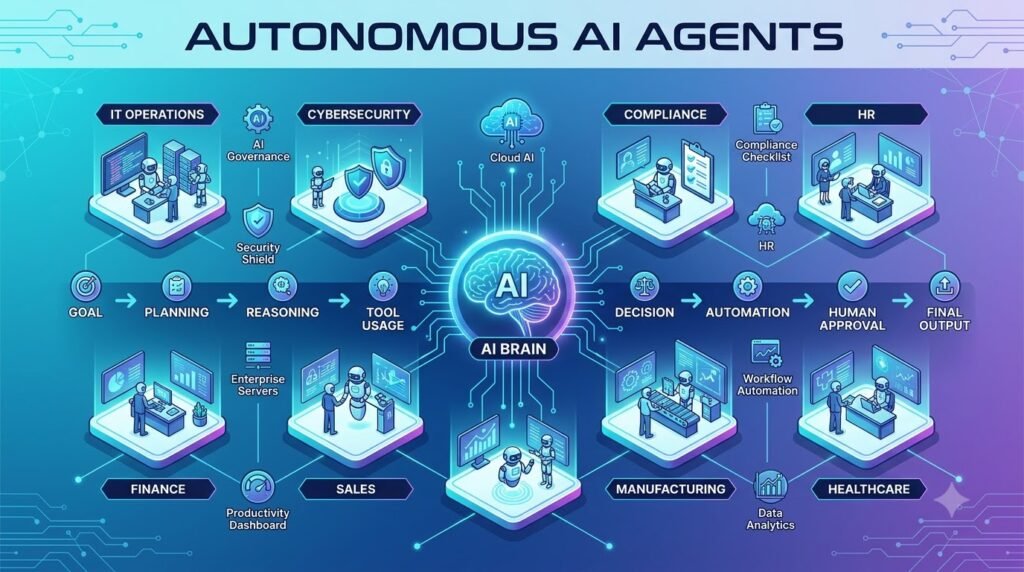
Enterprise AI Architecture Powered by Autonomous AI Agents
Earlier, enterprises mostly used AI as a chatbot or assistant.
Now,
Enterprise AI Architecture completely evolve ಆಗುತ್ತಿದೆ.
Traditional Workflow
Employee
↓
Collect Data
↓
Analyze Information
↓
Prepare Report
↓
Send Email
↓
Manual Approval
↓
Task Complete
Modern Enterprise Workflow
Business Request
↓
Autonomous AI Agents
↓
Reasoning
↓
Planning
↓
Tool Selection
↓
Data Collection
↓
Execution
↓
Human Approval (If Needed)
↓
Workflow Complete
ಈ architecture businessesಗೆ faster decision-making ಹಾಗೂ end-to-end automation provide ಮಾಡುತ್ತಿದೆ.
Multi-Agent Systems: The Next Evolution
ಒಬ್ಬ AI Agent ಎಲ್ಲಾ ಕೆಲಸ ಮಾಡಬೇಕೆಂದಿಲ್ಲ.
Future enterprises multiple Autonomous AI Agents together collaborate ಮಾಡುತ್ತವೆ.
Example:
Customer Complaint
↓
Customer Support AI Agent
↓
Finance AI Agent
↓
Inventory AI Agent
↓
Logistics AI Agent
↓
Manager Approval Agent
↓
Customer Resolution
ಪ್ರತಿ AI Agent ತನ್ನ own responsibility handle ಮಾಡುತ್ತದೆ.
ಈ concept ಅನ್ನು Multi-Agent System ಅಂತ ಕರೆಯುತ್ತಾರೆ.
Benefits:
✔ Faster Processing
✔ Better Accuracy
✔ Specialized Expertise
✔ Parallel Execution
✔ Lower Response Time
AI Memory Systems Explained: How AI Remembers Context in 2026
Human + AI Collaboration
AI employees replace ಮಾಡೋದಕ್ಕೆ ಅಲ್ಲ.
AI employeesಗೆ assistant ಆಗಿ ಕೆಲಸ ಮಾಡುತ್ತದೆ.
Example:
Marketing Team
↓
AI Research
↓
AI Content Draft
↓
Human Review
↓
Final Campaign
↓
Customer Launch
ಈ model productivity increase ಮಾಡುತ್ತದೆ while humans maintain creativity, ethics ಹಾಗೂ final decision-making.
AI Governance Lifecycle
Organizations AI deploy ಮಾಡಿದ ನಂತರ governance continuous process ಆಗಿರುತ್ತದೆ.
Lifecycle:
AI Development
↓
Testing
↓
Security Validation
↓
Compliance Review
↓
Deployment
↓
Monitoring
↓
Performance Evaluation
↓
Continuous Improvement
ಈ governance lifecycle responsible AI adoptionಗೆ essential.
Compliance Becomes a Business Priority
2026ರಲ್ಲಿ enterprises AI ಬಳಸುವಾಗ compliance ignore ಮಾಡಲು ಸಾಧ್ಯವಿಲ್ಲ.
Important areas:
Data Privacy
Customer information securely handle ಮಾಡಬೇಕು.
Regulatory Compliance
Country-specific AI regulations follow ಮಾಡಬೇಕು.
Industry Standards
Healthcare
Finance
Insurance
Government
ಪ್ರತಿ sectorಗೆ separate compliance requirements ಇರುತ್ತವೆ.
Audit Trail
AI ಮಾಡಿದ every important action record ಆಗಬೇಕು.
ಇದು transparency improve ಮಾಡುತ್ತದೆ.
Cybersecurity Meets Autonomous AI Agents
Cybersecurity teams ಕೂಡ AI Agents adopt ಮಾಡುತ್ತಿದ್ದಾರೆ.
Example:
Network Activity
↓
AI Monitoring
↓
Threat Detection
↓
Risk Analysis
↓
Security Response
↓
Incident Report
↓
Human Validation
ಈ automation cyber attacks detect ಮಾಡುವ speed increase ಮಾಡುತ್ತದೆ.
AI Agents in Customer Service
Traditional customer support:
Customer
↓
Call Center
↓
Waiting
↓
Manual Resolution
Modern Support:
Customer
↓
Autonomous AI Agent
↓
Customer History
↓
Knowledge Base
↓
Problem Analysis
↓
Solution
↓
Escalation (If Needed)
↓
Issue Closed
Customersಗೆ faster response ಹಾಗೂ personalized experience ಸಿಗುತ್ತದೆ.
AI Agents in Software Development
Software companies increasingly AI Agents use ಮಾಡುತ್ತಿವೆ.
Development Workflow
Requirement
↓
AI Planning Agent
↓
Coding Agent
↓
Testing Agent
↓
Security Review Agent
↓
Documentation Agent
↓
Developer Review
↓
Deployment
Developers repetitive work ಕಡಿಮೆ ಮಾಡಿ innovation ಮೇಲೆ ಹೆಚ್ಚು focus ಮಾಡಬಹುದು.
Top 12 AI Coding Agents That Boost Developer Productivity
AI Agents for Business Intelligence
Executives real-time insights ಬೇಕಾಗುತ್ತದೆ.
Earlier,
Analysts manually reports prepare ಮಾಡುತ್ತಿದ್ದರು.
Now,
Business Database
↓
Autonomous AI Agents
↓
Data Analysis
↓
Trend Detection
↓
Forecasting
↓
Executive Dashboard
↓
Strategic Decisions
Business leaders faster decisions ತೆಗೆದುಕೊಳ್ಳಬಹುದು.
AI Governance Best Practices
Organizations follow ಮಾಡಬೇಕಾದ best practices:
Define AI Policies
Clear AI usage rules.
Role-Based Access
Authorized users ಮಾತ್ರ AI tools access ಮಾಡಬೇಕು.
Human Oversight
Critical decisionsಗೆ human approval maintain ಮಾಡಬೇಕು.
Regular AI Audits
Performance ಹಾಗೂ compliance review ಮಾಡಬೇಕು.
Employee Training
Responsible AI usage educate ಮಾಡಬೇಕು.
Continuous Monitoring
AI behaviour continuously evaluate ಮಾಡಬೇಕು.
Open-Weight AI Models Explained: A Complete Guide to Benefits, Use Cases, and Future Trends
Read the NIST AI Risk Management Framework to understand best practices for AI governance, risk management, security, and responsible AI deployment.
Benefits for Global Enterprises
Autonomous AI Agents organizationsಗೆ significant value create ಮಾಡುತ್ತವೆ.
Major advantages:
✔ 24×7 Operations
✔ Faster Decision-Making
✔ Higher Productivity
✔ Reduced Manual Work
✔ Better Customer Experience
✔ Improved Compliance
✔ Intelligent Automation
✔ Lower Operational Costs
✔ Scalable Business Processes
✔ Better Employee Efficiency
Challenges Enterprises Still Face
Rapid adoption ಜೊತೆಗೆ ಕೆಲವು challenges ಕೂಡ continue ಆಗುತ್ತಿವೆ.
AI Hallucinations
Incorrect recommendations.
Integration Complexity
Legacy enterprise systems integrate ಮಾಡುವುದು difficult.
Security Risks
Unauthorized AI access prevent ಮಾಡಬೇಕು.
Governance Costs
Responsible AI infrastructure investment required.
Employee Adoption
Teams AI tools effectively use ಮಾಡಲು training ಅಗತ್ಯ.
Regulatory Changes
Global AI regulations continuously evolve ಆಗುತ್ತಿವೆ.
Organizations flexible governance strategy maintain ಮಾಡಬೇಕು.
Industries Leading AI Agent Adoption
Current enterprise adoption fastest growing sectors:
- Banking & Financial Services
- Healthcare
- Insurance
- Manufacturing
- Retail
- E-commerce
- Telecommunications
- Cybersecurity
- Logistics
- Government Services
- Education
- Energy
Almost every industry intelligent automation ಕಡೆ move ಆಗುತ್ತಿದೆ.
Enterprise AI Roadmap
Successful organizations usually follow this roadmap.
Business Goals
↓
Identify Repetitive Tasks
↓
Deploy Autonomous AI Agents
↓
Implement AI Governance
↓
Monitor Performance
↓
Scale Across Departments
↓
Continuous Improvement
ಈ roadmap long-term enterprise AI successಗೆ foundation ಆಗುತ್ತದೆ.
AI Workflow Automation Master Guide: Automate Business and Personal Tasks in 2026
The Future of Autonomous AI Agents
2026 AI industryನಲ್ಲಿ biggest transformation ಅಂದ್ರೆ Autonomous AI Agents. ಈಗ AI chatbots ಮಾತ್ರ answer ಕೊಡುವ stageನಿಂದ complete business execution stageಗೆ move ಆಗುತ್ತಿದೆ.
Future Enterprise
↓
Business Goal
↓
Autonomous AI Agents
↓
Reasoning
↓
Planning
↓
Tool Selection
↓
Execution
↓
Monitoring
↓
Business Outcome
ಅಂದರೆ futureನಲ್ಲಿ employees AIಗೆ task assign ಮಾಡುತ್ತಾರೆ, AI agents complete workflow execute ಮಾಡಿ final result deliver ಮಾಡುತ್ತವೆ.
Industry analysts expect agentic AI adoption to grow rapidly, but organizations that succeed will combine automation with strong governance and oversight.
AI Governance Will Become Mandatory
Earlier,
Companies focused on
✔ Productivity
✔ Automation
✔ Cost Savings
Now,
Organizations also prioritize
✔ AI Governance
✔ AI Security
✔ Compliance
✔ Transparency
✔ Auditability
Future Governance Workflow
AI Request
↓
Identity Verification
↓
Policy Validation
↓
Permission Check
↓
AI Execution
↓
Audit Logging
↓
Human Review (If Required)
↓
Task Complete
AI governance is shifting from an optional best practice to a core enterprise requirement as autonomous systems become more capable.
Autonomous AI Agents Across Industries
Almost every industry is preparing for AI Agent adoption.
Banking
Loan Processing
↓
Fraud Detection
↓
AML Verification
↓
Customer Support
↓
Compliance Monitoring
Healthcare
Patient Records
↓
Diagnosis Assistance
↓
Appointment Scheduling
↓
Medical Documentation
↓
Insurance Processing
Manufacturing
Production Planning
↓
Machine Monitoring
↓
Predictive Maintenance
↓
Inventory Management
↓
Quality Inspection
Retail
Customer Recommendations
↓
Demand Forecasting
↓
Order Processing
↓
Supply Chain Optimization
↓
Inventory Updates
Government
Citizen Services
↓
Document Verification
↓
Language Translation
↓
Public Support
↓
Digital Governance
Human Oversight Remains Essential
AI Agents powerful ಆಗಿದ್ದರೂ,
Human supervision ಇನ್ನೂ critical.
Best practice:
Business Request
↓
AI Agent
↓
Action Plan
↓
Human Approval
↓
Execution
↓
Monitoring
↓
Final Report
High-risk decisions always humans validate ಮಾಡಬೇಕು.
Experts continue to recommend proportional oversight based on the autonomy and impact of each AI agent.
Enterprise Security in the AI Agent Era
Future enterprise security model:
Identity
↓
Authentication
↓
Authorization
↓
Encrypted Communication
↓
Continuous Monitoring
↓
Threat Detection
↓
Incident Response
↓
Compliance Audit
Organizations increasingly treat AI agents like privileged digital workers with controlled identities and permissions rather than ordinary software.
Emerging Technologies Supporting AI Agents
Autonomous AI Agents work even better when integrated with other technologies.
Large Language Models (LLMs)
Reasoning and communication.
Open-Weight AI Models
Private deployment and customization.
Cloud Computing
Scalable enterprise execution.
Edge AI
Real-time local decision-making.
Robotics
Physical automation.
Internet of Things (IoT)
Smart device integration.
Digital Twins
Simulation before execution.
Together, these technologies create intelligent enterprise ecosystems rather than isolated AI applications.
Opportunities for Businesses
Organizations adopting Autonomous AI Agents strategically can achieve:
✔ Faster Business Operations
✔ Better Customer Experience
✔ Intelligent Decision-Making
✔ Lower Operational Costs
✔ Increased Productivity
✔ 24×7 Automation
✔ Improved Compliance
✔ Better Employee Efficiency
AI Agents allow human teams to spend more time on creativity, innovation and strategic planning instead of repetitive operational work.
Challenges That Still Need Attention
Despite rapid progress,
organizations must manage several risks.
AI Hallucinations
Incorrect recommendations.
Data Privacy
Sensitive information protection.
Agent Sprawl
Too many unmanaged AI agents across departments.
Cybersecurity
Preventing unauthorized AI actions.
Governance Complexity
Different AI agents require different levels of oversight.
Regulatory Compliance
Global AI regulations continue to evolve.
Analysts warn that poor governance can lead to “AI agent sprawl,” increasing operational, security and compliance risks.
Expert Insights
Technology leaders increasingly agree that successful AI adoption is no longer only about building smarter models.
Future success depends on:
- Governance by Design
- Secure Identity Management
- Continuous Monitoring
- Human Accountability
- Responsible AI Deployment
- Cross-functional Collaboration
Organizations that balance innovation with governance are expected to scale AI more successfully than those focused only on automation.
Discover Deloitte’s insights on enterprise AI governance, autonomous AI agents, compliance, and responsible AI transformation.
Frequently Asked Questions (FAQs)
1. What are Autonomous AI Agents?
Autonomous AI Agents are AI systems that can plan, reason, use tools, make decisions and complete multi-step tasks with limited human intervention.
2. Why are enterprises adopting Autonomous AI Agents?
Businesses use them to automate workflows, improve productivity, reduce operational costs, enhance customer experiences and accelerate decision-making.
3. Why is AI governance important?
AI governance helps ensure AI systems operate securely, transparently and in compliance with organizational policies and regulations.
4. Can Autonomous AI Agents replace employees?
No.
In most enterprise environments, AI Agents are designed to augment human workers by automating repetitive tasks while humans retain responsibility for strategic and high-impact decisions.
5. What is the future of Autonomous AI Agents?
Future developments include:
- Multi-Agent Systems
- Enterprise AI Platforms
- AI-powered Robotics
- Edge AI
- AI Governance Platforms
- Intelligent Business Automation
- Digital Workers
- Autonomous Enterprise Operations
Future Trends to Watch
Over the next few years, enterprises are expected to invest heavily in:
- Enterprise AI Control Planes
- AI Governance Platforms
- Agent Identity Management
- Multi-Agent Collaboration
- AI Security Frameworks
- AI Compliance Automation
- Industry-Specific AI Agents
- Autonomous Business Operations
- Responsible AI Technologies
- Hybrid Human + AI Workforce
These trends indicate that the next phase of AI is focused not only on smarter agents but also on trustworthy deployment at scale.
Explore IBM’s AI governance resources covering enterprise AI, AI agents, model governance, compliance, and responsible AI implementation.
Final Verdict
Autonomous AI Agents represent one of the most significant shifts in enterprise technology.
Instead of merely assisting employees, they can coordinate information, interact with enterprise systems, execute workflows and support faster business outcomes.
However, organizations that invest in governance, cybersecurity, transparency and human oversight will be better positioned to unlock the full value of autonomous AI while minimizing operational risks.
Conclusion
Artificial Intelligence is entering a new era where software is evolving from passive assistants into active digital coworkers.
With Autonomous AI Agents, enterprises can automate complex workflows across finance, healthcare, manufacturing, retail, government and many other sectors. At the same time, responsible AI governance, security controls and human accountability remain essential to ensure these systems operate safely and effectively.
ಮುಂದಿನ ಕೆಲವು ವರ್ಷಗಳಲ್ಲಿ Autonomous AI Agents enterprise digital transformationಗೆ ಪ್ರಮುಖ driving force ಆಗಲಿವೆ. Businesses that build secure, governed and scalable AI ecosystems today will be better prepared for the future of intelligent automation.
Key Takeaways
- Autonomous AI Agents can independently plan and execute multi-step business tasks.
- AI governance is becoming a strategic business priority.
- Human oversight remains essential for critical decisions.
- Multi-Agent Systems will become increasingly common.
- AI security, compliance and auditability are vital for enterprise adoption.
- Organizations should implement identity, access controls and continuous monitoring for AI agents.
- Autonomous AI Agents will reshape productivity across industries.
- Responsible governance will determine long-term success in enterprise AI.
Final Article Summary
ಈ ಮೂರು ಭಾಗಗಳ articleನಲ್ಲಿ Autonomous AI Agents ಬಗ್ಗೆ comprehensive understanding ಪಡೆದಿದ್ದೇವೆ.
Part 1ನಲ್ಲಿ Autonomous AI Agents ಎಂದರೇನು, enterprises ಯಾಕೆ adopt ಮಾಡುತ್ತಿವೆ, AI governance importance, business benefits ಹಾಗೂ industry adoption ಬಗ್ಗೆ ತಿಳಿದುಕೊಂಡೆವು.
Part 2ನಲ್ಲಿ enterprise AI architecture, Multi-Agent Systems, Human + AI collaboration, cybersecurity, compliance, customer service, software development, business intelligence ಹಾಗೂ enterprise AI roadmap ಕುರಿತು Hybrid English + Kannadaನಲ್ಲಿ ವಿವರವಾಗಿ ನೋಡಿದೆವು.
Part 3ನಲ್ಲಿ future trends, AI governance evolution, enterprise security, emerging technologies, expert insights, FAQs, conclusion ಹಾಗೂ key takeaways ಕುರಿತು ಆಳವಾಗಿ ತಿಳಿದುಕೊಂಡೆವು.
ಒಟ್ಟಿನಲ್ಲಿ, Autonomous AI Agents are transforming global enterprises from simple AI-assisted workflows to intelligent, autonomous business operations. ಆದರೆ sustainable successಗಾಗಿ AI governance, security, transparency, compliance ಮತ್ತು human oversight equally important. Innovation ಹಾಗೂ responsibility ಎರಡನ್ನೂ balance ಮಾಡುವ organizations ಮುಂದಿನ AI-powered enterprise eraನಲ್ಲಿ competitive advantage ಪಡೆಯುವ ಸಾಧ್ಯತೆ ಹೆಚ್ಚು.