
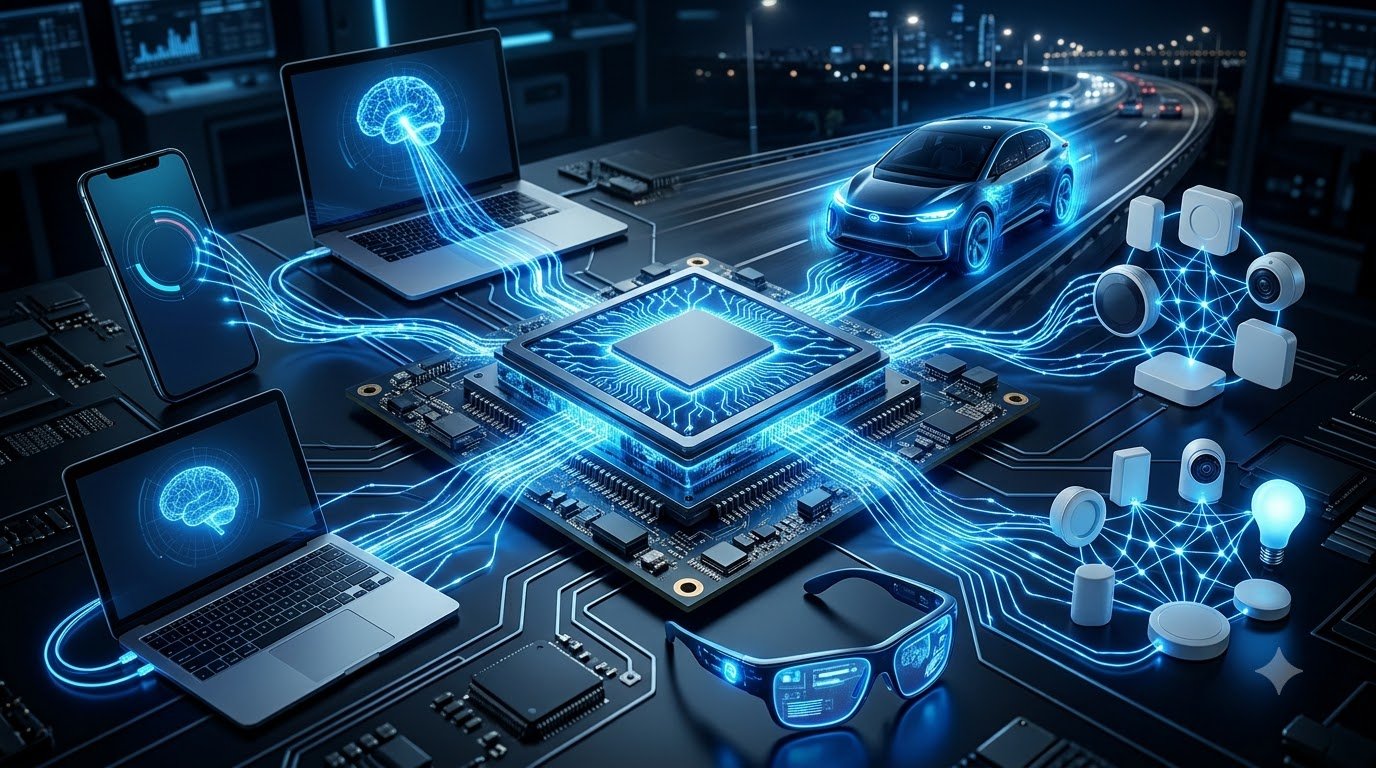
Next-Generation AI Chips Deliver Faster On-Device Intelligence
Introduction
Artificial Intelligence ಈಗ cloud serversನಲ್ಲಿ ಮಾತ್ರ run ಆಗುವುದಿಲ್ಲ. Next-Generation AI Chips introduction ನಂತರ AI directly smartphones, laptops, wearable devices ಹಾಗೂ autonomous systemsನಲ್ಲಿ run ಆಗುತ್ತಿದೆ. ಇದನ್ನೇ On-Device AI ಎಂದು ಕರೆಯಲಾಗುತ್ತದೆ.
Earlier AI models process ಮಾಡಲು cloud servers ಮೇಲೆ depend ಆಗಬೇಕಾಗಿತ್ತು. ಆದರೆ modern AI chips powerful Neural Processing Units (NPUs), AI accelerators ಹಾಗೂ optimized architectures ಬಳಸಿಕೊಂಡು internet connection ಇಲ್ಲದಿದ್ದರೂ AI tasks execute ಮಾಡಬಲ್ಲವು.
ಈ technological shift faster performance, better privacy ಹಾಗೂ lower latency provide ಮಾಡುತ್ತಿರುವುದರಿಂದ industries across the world edge AI solutions ಕಡೆ move ಆಗುತ್ತಿವೆ.
What Are Next-Generation AI Chips?
Next-Generation AI Chips are specialized processors designed specifically for Artificial Intelligence workloads.
Traditional CPUs general computing handle ಮಾಡುತ್ತವೆ.
GPUs parallel processingಗೆ suitable.
ಆದರೆ AI Chips specially optimize ಆಗಿರುವುದು:
- Neural network inference
- Machine learning
- Computer vision
- Speech recognition
- Natural language processing
- Image generation
- Edge AI
- Robotics
ಇವು AI workloads faster ಹಾಗೂ energy-efficient ಆಗಿ execute ಮಾಡುತ್ತವೆ.
Explore how NVIDIA AI hardware accelerates next-generation AI computing for edge devices, robotics, and enterprise applications.
AI Memory Systems Explained: How AI Remembers Context in 2026
Why AI Chips Are Becoming Important
Modern applications huge amount of AI processing require ಮಾಡುತ್ತವೆ.
Examples:
- AI smartphones
- Smart cameras
- Autonomous vehicles
- Healthcare devices
- Industrial robots
- Smart homes
- Wearable devices
- AI PCs
Cloud dependency reduce ಮಾಡಲು organizations Next-Generation AI Chips adopt ಮಾಡುತ್ತಿವೆ.
What Is On-Device Intelligence?
On-Device Intelligence ಅಂದರೆ AI processing directly deviceನಲ್ಲೇ ನಡೆಯುವುದು.
Instead of sending every request to cloud servers:
Device →
AI Chip →
Instant Processing →
Immediate Result
Benefits include:
- Faster response
- Better privacy
- Lower latency
- Offline capability
- Reduced bandwidth
- Better battery efficiency
ಇದರಿಂದ user experience significantly improve ಆಗುತ್ತದೆ.
Key Technologies Behind Next-Generation AI Chips
Modern AI processors combine several advanced technologies.
Neural Processing Units (NPUs)
Dedicated AI engines for machine learning tasks.
AI Accelerators
Complex AI calculations speed up ಮಾಡುತ್ತವೆ.
Edge Computing
Data locally process ಮಾಡುತ್ತದೆ.
Low-Power Architecture
Battery consumption significantly reduce ಮಾಡುತ್ತದೆ.
High Memory Bandwidth
Large AI models efficiently execute ಮಾಡಬಹುದು.
Advanced Semiconductor Design
Higher performance with improved thermal efficiency.
Top 12 AI Coding Agents That Boost Developer Productivity
How Next-Generation AI Chips Work
Step 1
User gives an AI command.
↓
Step 2
AI Chip receives the request.
↓
Step 3
Neural Processing Unit analyzes data.
↓
Step 4
Machine learning model executes locally.
↓
Step 5
Result generated instantly.
↓
Step 6
User receives fast AI response.
Cloud communication only required when necessary.
Industries Benefiting from AI Chips
Next-Generation AI Chips are transforming multiple industries.
Major sectors include:
- Consumer Electronics
- Automotive
- Healthcare
- Manufacturing
- Smart Cities
- Agriculture
- Robotics
- Aerospace
Edge AI adoption continues to grow because local processing reduces latency and enhances privacy.
Benefits of Next-Generation AI Chips
Organizations and consumers both benefit.
Faster AI Performance
Real-time processing without delays.
Improved Privacy
Sensitive data remains on the device.
Offline AI
Many AI features continue working without internet.
Lower Latency
Instant responses improve user experience.
Better Battery Life
Optimized AI hardware consumes less power.
Reduced Cloud Costs
Less dependence on remote computing infrastructure.
Enhanced Security
Local AI processing reduces unnecessary data transmission.
AI Browsers Explained: The Future of Web Browsing
Challenges of AI Chips
Despite rapid innovation, several challenges remain.
High Development Cost
Advanced semiconductor manufacturing requires huge investments.
Heat Management
Powerful AI chips generate significant heat.
Manufacturing Complexity
Smaller semiconductor nodes increase production difficulty.
Supply Chain
Global semiconductor demand remains very high.
Software Optimization
Applications must be optimized for new AI hardware.
Small Language Models vs LLMs: Which Wins?
Real-World Examples
Several technology companies are investing heavily in Next-Generation AI Chips.
Examples include:
- Apple Neural Engine
- Qualcomm Snapdragon AI Engine
- Google Tensor
- Intel AI PC Processors
- AMD Ryzen AI
- NVIDIA Edge AI Platforms
- MediaTek Dimensity AI
- Samsung Exynos AI
These processors enable advanced AI experiences directly on consumer devices.

How Next-Generation AI Chips Are Transforming Edge AI
Earlier, most AI applications depended on cloud computing. Every AI request was sent to remote servers for processing, which sometimes caused delays and required a stable internet connection.
Today, Next-Generation AI Chips are changing this completely. AI processing now happens directly inside smartphones, AI PCs, smart cameras, drones, autonomous vehicles, and IoT devices. ಇದನ್ನೇ Edge AI ಎಂದು ಕರೆಯಲಾಗುತ್ತದೆ.
Edge AI offers:
- Faster response time
- Better privacy
- Offline AI capabilities
- Lower network latency
- Reduced cloud dependency
- Higher operational efficiency
ಈ transformation businesses ಮತ್ತು consumers ಇಬ್ಬರಿಗೂ significant advantages ನೀಡುತ್ತಿದೆ.
AI Chips vs Traditional Processors
Modern AI workloads traditional processorsಗಿಂತ completely different requirements ಹೊಂದಿವೆ.
| Feature | CPU | GPU | Next-Generation AI Chips |
|---|---|---|---|
| General Computing | Excellent | Moderate | Limited |
| AI Inference | Moderate | High | Excellent |
| Machine Learning | Moderate | High | Optimized |
| Power Efficiency | Moderate | Low | Very High |
| Real-Time AI | Limited | Good | Excellent |
| Edge AI | Basic | Moderate | Best Choice |
| Battery Optimization | Moderate | Low | High |
| Privacy | Depends on Cloud | Moderate | Excellent |
ಇದರಿಂದ AI-specific hardware future computingನಲ್ಲಿ increasingly important ಆಗುತ್ತಿದೆ.
AI Chips in Smartphones
Modern flagship smartphones increasingly rely on Next-Generation AI Chips.
Popular AI-powered features include:
AI Photography
Photos automatically enhance ಆಗುತ್ತವೆ.
Voice Assistants
Voice commands faster process ಆಗುತ್ತವೆ.
Live Translation
Languages instantly translate ಮಾಡಬಹುದು.
AI Writing Tools
Emails, messages ಹಾಗೂ documents generate ಮಾಡಲು assist ಮಾಡುತ್ತವೆ.
Smart Battery Management
AI user behavior learn ಮಾಡಿ battery optimize ಮಾಡುತ್ತದೆ.
On-Device Generative AI
Several premium smartphones now run compact AI models locally for text generation, image editing and voice processing without sending every request to the cloud.
Learn how Qualcomm AI Engine powers on-device AI experiences in modern smartphones and edge computing devices.
AI PCs and Laptops
AI PCs are becoming one of the biggest technology trends.
Modern laptops equipped with Next-Generation AI Chips offer:
- AI video enhancement
- Background noise removal
- Live captions
- Smart document creation
- AI coding assistance
- Image generation
- Real-time transcription
- Intelligent performance optimization
Dedicated NPUs allow these AI features to run efficiently while reducing CPU and GPU workload.
Discover how Intel AI PCs use dedicated Neural Processing Units (NPUs) to deliver faster and more efficient on-device AI.
AI Chips in Autonomous Vehicles
Self-driving technologies heavily depend on Next-Generation AI Chips.
AI processors handle:
Object Detection
Road objects identify ಮಾಡುತ್ತವೆ.
Lane Detection
Driving lanes recognize ಮಾಡುತ್ತವೆ.
Traffic Prediction
Traffic conditions analyze ಮಾಡುತ್ತವೆ.
Driver Monitoring
Driver attention monitor ಮಾಡುತ್ತವೆ.
Collision Avoidance
Potential accidents predict ಮಾಡಿ quick decisions support ಮಾಡುತ್ತವೆ.
Real-time processing is critical because autonomous systems cannot wait for cloud responses.
AI Chips in Healthcare
Healthcare industry rapidly adopting on-device AI.
Applications include:
- Medical imaging
- Disease detection
- Wearable health monitoring
- ECG analysis
- Remote diagnostics
- Patient monitoring
- AI-assisted surgery
- Portable diagnostic devices
Local AI processing improves privacy because sensitive medical data can remain on the device whenever possible.
AI Chips for Smart Homes
Smart homes increasingly use Next-Generation AI Chips.
Examples:
- Smart speakers
- AI security cameras
- Home automation
- Smart thermostats
- Energy optimization
- Voice-controlled appliances
- AI lighting systems
- Smart door locks
On-device intelligence enables faster automation even when internet connectivity is limited.
Semiconductor Innovations Driving AI Chips
Recent semiconductor advancements continue improving AI performance.
Key innovations include:
Smaller Manufacturing Nodes
More transistors fit into smaller chips.
Advanced Packaging
Improves communication between chip components.
High-Bandwidth Memory (HBM)
Supports faster AI data processing.
Energy-Efficient NPUs
Deliver better AI performance with lower power consumption.
Chiplet Architecture
Multiple specialized chip modules work together efficiently.
These innovations enable AI hardware to become more powerful while maintaining better energy efficiency.
Enterprise Benefits
Organizations investing in Next-Generation AI Chips gain several advantages.
Faster Decision-Making
AI processes data locally with minimal delay.
Reduced Cloud Costs
Less dependence on remote computing infrastructure.
Improved Data Privacy
Sensitive business information stays closer to where it is generated.
Better Reliability
Critical AI applications continue functioning during temporary network disruptions.
Scalability
Organizations can deploy AI across millions of edge devices.
Challenges Ahead
Although AI chip technology is advancing rapidly, several challenges remain.
High Manufacturing Cost
Advanced semiconductor fabrication requires billions of dollars in investment.
Supply Chain Constraints
Global demand for AI chips continues to exceed supply in some segments.
Heat Dissipation
Powerful AI hardware requires efficient cooling solutions.
Software Compatibility
Applications must be optimized to fully utilize dedicated AI processors.
Sustainability
Manufacturers are working to reduce energy consumption while improving AI performance.
Latest Developments
The AI semiconductor industry continues to evolve with rapid innovation.
Recent developments include:
- More powerful NPUs for consumer devices
- AI-first processors for laptops
- Edge AI chips for industrial automation
- Automotive AI processors for autonomous driving
- AI accelerators for robotics
- More efficient semiconductor manufacturing
- Hybrid CPU-GPU-NPU architectures
- Improved on-device generative AI capabilities
These advancements are making AI more accessible across consumer electronics, enterprise systems and industrial applications.
The Future of Next-Generation AI Chips
The future of Next-Generation AI Chips looks incredibly promising. Earlier, Artificial Intelligence mostly depended on powerful cloud servers. ಆದರೆ ಈಗ AI processing gradually move ಆಗುತ್ತಿರುವುದು edge devices ಕಡೆಗೆ.
In the coming years, smartphones, AI PCs, autonomous vehicles, wearable devices, industrial robots, and smart home systems will increasingly rely on Next-Generation AI Chips to deliver faster, safer, and more efficient AI experiences.
Future innovations are expected to include:
- AI-first processors
- Advanced Neural Processing Units (NPUs)
- Ultra-low power AI chips
- On-device Generative AI
- AI-enabled robotics
- Intelligent IoT devices
- AI-powered medical equipment
- Smart industrial automation
ಈ innovations AI ಅನ್ನು everyday lifeನ essential part ಆಗಿ transform ಮಾಡಲಿವೆ.
Explore Google’s latest AI research, machine learning innovations, and AI hardware technologies.
Why On-Device AI Is the Future
Cloud AI powerful ಆಗಿದ್ದರೂ every AI request cloudಗೆ send ಮಾಡುವುದು practical ಅಲ್ಲ.
On-Device AI provides several advantages.
Better Privacy
Sensitive personal data deviceನಲ್ಲೇ remain ಆಗುತ್ತದೆ.
Faster Processing
Cloud latency avoid ಆಗುತ್ತದೆ.
Offline Intelligence
Internet connection ಇಲ್ಲದಿದ್ದರೂ AI features work ಮಾಡಬಹುದು.
Lower Operational Cost
Cloud computing expenses reduce ಆಗುತ್ತವೆ.
Energy Optimization
Modern AI chips consume less power while delivering higher performance.
Industry leaders increasingly view hybrid AI—combining on-device processing with cloud AI—as the most practical long-term approach.
Industries That Will Benefit the Most
Next-Generation AI Chips almost every industryನಲ್ಲಿ major transformation create ಮಾಡುತ್ತಿವೆ.
Healthcare
Portable AI diagnostic devices faster medical decisions support ಮಾಡುತ್ತವೆ.
Automotive
Self-driving vehicles real-time road analysis perform ಮಾಡುತ್ತವೆ.
Manufacturing
Factories predictive maintenance ಹಾಗೂ quality inspection automate ಮಾಡುತ್ತವೆ.
Education
Students AI tutors ಹಾಗೂ personalized learning systems use ಮಾಡಬಹುದು.
Agriculture
AI-powered drones crops monitor ಮಾಡಿ precision farming improve ಮಾಡುತ್ತವೆ.
Smart Cities
Traffic management, surveillance ಹಾಗೂ energy optimization AI ಮೂಲಕ more efficient ಆಗುತ್ತವೆ.
Consumer Electronics
Smartphones, laptops ಹಾಗೂ wearable devices smarter ಹಾಗೂ faster ಆಗುತ್ತವೆ.
Challenges That Need Attention
Although Next-Generation AI Chips rapidly evolve ಆಗುತ್ತಿದ್ದರೂ ಕೆಲವು important challenges remain.
Semiconductor Manufacturing Cost
Advanced chip fabrication requires billions of dollars in investment.
Global Supply Chain
High demand sometimes affects chip availability.
AI Software Optimization
Applications must be optimized for dedicated NPUs and AI accelerators.
Thermal Management
Powerful AI processors require better cooling technologies.
Sustainability
Manufacturers are focusing on reducing energy consumption and improving recyclable semiconductor manufacturing.
Addressing these challenges will help accelerate the global adoption of on-device AI.
Best Practices for Businesses
Organizations planning to adopt Next-Generation AI Chips should follow these best practices.
Choose AI-Optimized Hardware
Invest in devices with dedicated NPUs.
Build Hybrid AI Infrastructure
Use on-device AI for real-time tasks and cloud AI for large-scale processing.
Prioritize Security
Implement secure boot, encrypted storage and hardware-level protection.
Train Employees
Help teams understand AI-enabled hardware capabilities.
Optimize Applications
Ensure software is designed to fully utilize AI accelerators.
Monitor Performance
Regularly evaluate AI workloads, power efficiency and hardware utilization.
Frequently Asked Questions (FAQs)
1. What are Next-Generation AI Chips?
Next-Generation AI Chips are specialized semiconductor processors designed to efficiently execute Artificial Intelligence workloads such as machine learning, computer vision, speech recognition and generative AI.
2. What is On-Device AI?
On-Device AI means AI models run directly on smartphones, laptops, vehicles or IoT devices instead of sending every request to cloud servers.
3. Why are AI Chips faster than traditional processors?
They include dedicated Neural Processing Units (NPUs) and AI accelerators specifically optimized for AI calculations, reducing processing time and power consumption.
4. Which devices use AI Chips?
Examples include:
- Smartphones
- AI PCs
- Smart cameras
- Wearable devices
- Autonomous vehicles
- Industrial robots
- Smart home devices
- Medical equipment
5. Will AI Chips replace cloud computing?
No.
Future AI ecosystems will likely combine On-Device AI and cloud computing. Devices will handle real-time processing locally, while cloud platforms will continue supporting large-scale AI model training and complex computational workloads.
Expert Insights
Technology experts believe AI hardware will become one of the most important drivers of future innovation.
Experts recommend:
- Invest in AI-ready hardware.
- Build efficient edge AI solutions.
- Combine cloud AI with on-device intelligence.
- Improve AI software optimization.
- Focus on power-efficient semiconductor design.
- Strengthen hardware security.
- Develop scalable AI ecosystems.
- Encourage responsible AI deployment.
Many analysts expect dedicated NPUs to become as common in future consumer devices as CPUs and GPUs are today.
Future Trends to Watch
The Next-Generation AI Chips ecosystem continues evolving rapidly.
Major trends include:
- AI PCs with advanced NPUs
- AI smartphones capable of local generative AI
- Edge AI servers
- AI robotics processors
- Automotive AI SoCs
- Neuromorphic computing research
- Chiplet-based AI architectures
- Energy-efficient semiconductor manufacturing
- AI-powered wearable devices
- TinyML for ultra-low-power IoT devices
These innovations will enable smarter, faster and more secure AI experiences across industries.
Learn how Arm is enabling energy-efficient AI chips for smartphones, IoT devices, automotive systems, and edge computing.
Final Verdict
Next-Generation AI Chips are becoming the foundation of the next wave of Artificial Intelligence.
Instead of relying solely on cloud computing, organizations and consumers are increasingly embracing On-Device AI for better privacy, lower latency and faster decision-making.
As semiconductor technology continues to advance, AI chips will play a critical role in powering intelligent devices across every sector.
Conclusion
Artificial Intelligence is entering a new era where intelligence is no longer limited to cloud data centers.
Next-Generation AI Chips are enabling AI to run directly on devices, making applications faster, more secure and more energy efficient.
From smartphones and laptops to autonomous vehicles and healthcare devices, these advanced processors are transforming how people interact with technology. As AI hardware and semiconductor innovation continue to evolve, Next-Generation AI Chips will become one of the most important technologies driving the future of intelligent computing.
Key Takeaways
- Next-Generation AI Chips enable faster and more efficient AI processing.
- On-device AI improves privacy, speed and offline functionality.
- Dedicated NPUs reduce dependence on cloud computing.
- AI chips are transforming smartphones, AI PCs, healthcare and autonomous vehicles.
- Hybrid AI architectures combining edge and cloud computing represent the future.
- Energy-efficient semiconductor innovation is accelerating AI adoption.
- AI hardware will play a central role in the next generation of intelligent devices.
- Businesses investing in AI-ready infrastructure will gain long-term competitive advantages.
Final Article Summary
ಈ ಮೂರು ಭಾಗಗಳ articleನಲ್ಲಿ Next-Generation AI Chips ಬಗ್ಗೆ ಸಂಪೂರ್ಣವಾಗಿ ತಿಳಿದುಕೊಂಡೆವು. ಮೊದಲ ಭಾಗದಲ್ಲಿ AI chips ಎಂದರೇನು, On-Device AI ಹೇಗೆ work ಮಾಡುತ್ತದೆ, ಪ್ರಮುಖ technologies, benefits ಹಾಗೂ challenges ಬಗ್ಗೆ ತಿಳಿದುಕೊಂಡೆವು.
ಎರಡನೇ ಭಾಗದಲ್ಲಿ AI smartphones, AI PCs, autonomous vehicles, healthcare, smart homes, semiconductor innovations, enterprise benefits ಹಾಗೂ latest AI hardware developments ಬಗ್ಗೆ Hybrid English + Kannadaನಲ್ಲಿ ವಿವರವಾಗಿ ನೋಡಿದೆವು.
ಈ ಮೂರನೇ ಭಾಗದಲ್ಲಿ future trends, industry applications, best practices, FAQs, expert insights, conclusion ಹಾಗೂ key takeaways ಬಗ್ಗೆ ಸಂಪೂರ್ಣವಾಗಿ ತಿಳಿದುಕೊಂಡೆವು.
ಒಟ್ಟಿನಲ್ಲಿ, Next-Generation AI Chips ಕೇವಲ faster processors ಅಲ್ಲ; ಅವು future intelligent computingಗೆ backbone ಆಗಿದ್ದು, On-Device AI ಮೂಲಕ privacy, speed, security ಹಾಗೂ real-time intelligence ಅನ್ನು ಹೊಸ ಮಟ್ಟಕ್ಕೆ ತೆಗೆದುಕೊಂಡು ಹೋಗುತ್ತಿವೆ. Organizations, developers ಮತ್ತು consumers ಈ technology ಅನ್ನು early adopt ಮಾಡಿದಂತೆ ಮುಂದಿನ AI revolutionನಲ್ಲಿ ಹೆಚ್ಚಿನ ಪ್ರಯೋಜನ ಪಡೆಯುವ ಸಾಧ್ಯತೆ ಇದೆ.